The Prime – Halftime Report

NASA – Public Domain

I still haven’t come up with an image to use with this book.

I have been writing my current novel — tentatively titled The Prime — for three months now, and I’m halfway through. That means it’s time for a halftime report, just like during a sports game, or any project where the participants want to assess their work so far. It’s good to see if we’re meeting our goals, and to plan the strategy for the second half.

Unlike my last book — The Plainsrunner — this one isn’t being shared in a serialization as I write it. At least not yet. That serialization was good in many ways, and I mostly enjoyed it. On the negative side, it was a lot of work, and that effort didn’t result in much return. Not only did it not result in many sales, it also didn’t even result in any reviews, and that has left me feeling that there wouldn’t be much point in doing another one.

I would like to say that I’m enjoying writing this book, but it feels strange to not be sharing it as we go. In addition to the serialization of the last one, I have shared portions of other uncompleted novels too. The first one, Green Comet, was released whole and complete. The second one, Parasite Puppeteers, was released as eight extensions, and The Francesians as four. I discovered as I went that there’s a lot of work involved in proofing and formatting and releasing and announcing several different versions of a story, and four is easier than eight. Now, with The Prime, it looks as if I’ve brought it down to zero. Right back to the first one.

So, what am I enjoying about writing The Prime? What I always enjoy about writing. Thinking every day about the growing story. Seeing it develop as I write it, seeing what happens next. Learning more about my characters as I get to know them better. Showing them where we’re going, and following along as they take us there. And sometimes reining them in as they head off in directions of their own.

It’s a bit lonelier this time, writing the whole thing without sharing it as we go, but a writer’s life is supposed to be a lonely one, isn’t it?

So there’s the halftime report on my novel, The Prime. So far, so good. Now it’s another three months of writing, then there’s the proofing, preparing it for publication and recording it. Oh yeah, and finding an image for it. Pen up, head down and back to work.

rjb
Posted in Uncategorized | Tagged , , , , , , , | Leave a comment

Transliterations of Alien Texts


People ask why I use human referents in my stories about aliens. Why, for instance, did Archie take the name Archimedes when his history doesn’t include Archimedes? Shouldn’t Archie have named himself after a great mathematician from his own world? The answer is, he did, and I’ve substituted that alien name with one we recognize immediately. I have communicated why he chose the name without having to write an explanation of his history into the story. I have saved the reader a lot of reading, and myself a lot of writing, if only we agree to imagine the alien equivalent when we see a human referent.

Rather than thinking of these stories as translations of alien texts, I think of them as whole-text transliterations, where I present the human equivalent and not the raw result. So, if you will agree with me to use this shorthand, we will save ourselves both a lot of work.

rjb

Posted in Uncategorized | Tagged , , , , , , , , | 2 Comments

Cavum

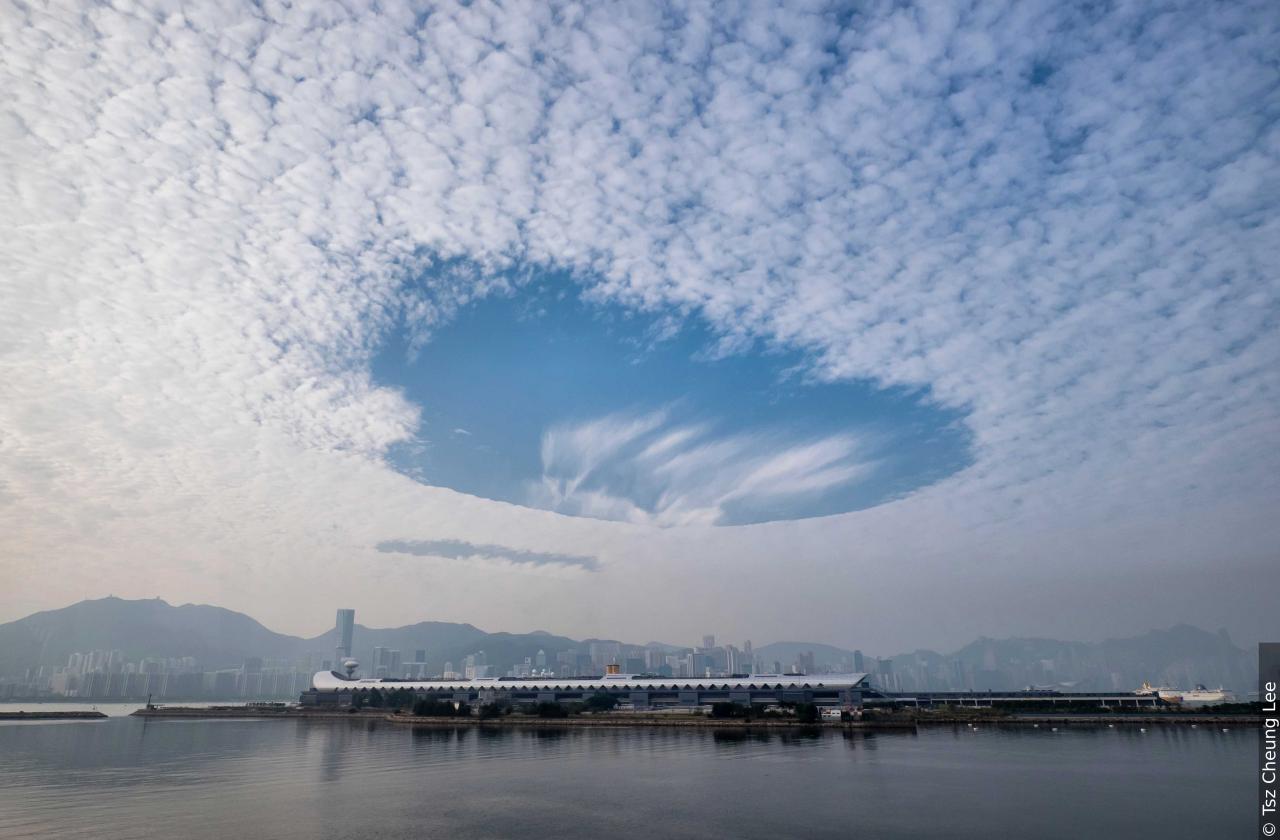
Copyright Tsz Cheung Lee

Cavum is one of the new clouds that show up in the latest edition of the World Meteorological Organization’s International Cloud Atlas. I reported on the release of the new edition in this post. Cavum is really just a new name for a cloud type previously known as a fall streak hole, which I reported on here. There are more great pictures in that post. The full name for the example shown in this post is altocumulus stratiformis perlucidus translucidus cavum. That is, the middle etage cloud altocumulus (my previous post on altocumulus) which is in a layer thin enough to allow light through, and which has gaps between its elements and a great big hole with virga in it. Here’s how cavum is described in the International Cloud Atlas.

A well-defined generally circular (sometimes linear) hole in a thin layer of supercooled water droplet cloud. Virga or wisps of Cirrus typically fall from the central part of the hole, which generally grows larger with time. Cavum is typically a circular feature when viewed from directly beneath, but may appear oval shaped when viewed from a distance.

When resulting directly from the interaction of an aircraft with the cloud, it is generally linear (in the form of a dissipation trail). Virga typically falls from the progressively widening dissipation trail.

Occurs in Altocumulus and Cirrocumulus and rarely Stratocumulus.

And here’s the description of the image from the International Cloud Atlas.

This thin, translucent and extensive layer of cloud is Altocumulus stratiformis translucidus. In the top part of the picture it also displays the variety perlucidus, as there are the gaps between the cloud elements. However, the most striking feature is the large, roughly circular hole beneath which there is virga. The large hole is the supplementary feature cavum, popularly known as a “fallstreak hole” or “hole-punch cloud”. The full classification for the cloud is therefore Altocumulus stratiformis perlucidus translucidus cavum.

Also of note is a linear gap in the cloud between the fallstreak hole and the horizon. This is an aircraft dissipation trail, or distrail, formed as a result of an aircraft flying through the cloud layer. Informally this is sometimes known as a “canal cloud”. It later transformed into a circular-type hole.

The supplementary feature cavum is formed when glaciation occurs in a thin cloud layer consisting of supercooled water droplets that are in a liquid state and at a temperature below 0°C. As the supercooled water drops glaciate, the resulting ice crystals fall from the cloud layer to a lower level as virga, or fallstreaks. The resulting cloud hole typically grows larger with time while the glaciation process continues.

There’s not much I can add to that, except to invite you to visit the International Cloud Atlas website.

rjb

Posted in Uncategorized | Tagged , , , , | 2 Comments