Alzheimer Precursor

Public domain

Public domain

Is this a precursor to Alzheimer Syndrome?

Researchers at the University of Eastern Finland have found a correlation between cynical distrust and a higher diagnosis rate for Alzheimer disease later in life. There seems to be a link between cynicism – assuming the worst about the motives of others – and dementia. So is it safe to say that cynical distrust is an Alzheimer precursor? Maybe. Then, can we say that cynicism causes dementia? No. Correlation is not causation. The fact that cynicism and distrust of others seems to be an Alzheimer precursor does not mean that it causes it, as the researchers were careful to point out.

Public domain

Public domain

It’s possible that cynicism is just one trait of an overall ‘negative’ personality, and this is another example of attitude affecting health. It may be part of a personality type that makes a person less likely to lead a healthy life. It could even be that the distrustful trait is one of the early signs of dementia, and that the causation goes the other way. The researchers stress that their small study is not definitive. They’re hoping that other, larger studies will be conducted to clarify the matter.

dementia

Even though this correlation is not definitive, previous studies have shown a link between cynical distrust and other problems, such as coronary disease. So the message is to lighten up. Negative thoughts can make you sick.

rjb

Posted in Uncategorized | Tagged , , , , , , | 5 Comments

Crepuscular Rays

Photo credit - Brocken Inaglory - CC-BY-SA

Photo credit – Brocken Inaglory – CC-BY-SA

Cloud of the Day – Crepuscular Rays

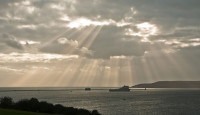
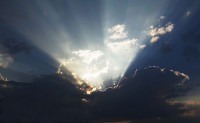
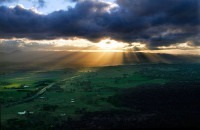
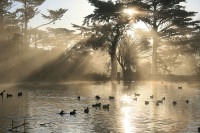
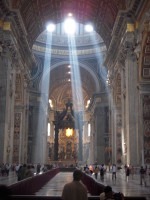
Isn’t it odd that one of the most beautiful meteorological phenomena has the ugliest name – crepuscular rays? Or is it just me? Maybe the word “crepuscular” sounds beautiful to most people. According to The Free Dictionary, the word comes from the Latin crepusculum, which means twilight. As such, crepuscular also refers to animals that are primarily active during twilight. That includes dawn or dusk, bright moonlight and dim days. For our purposes here though, it’s crepuscular rays, sometimes called God rays, of course.

Crepuscular rays are rays of sunlight that stream through gaps in clouds or other objects, so you get alternating bright shafts of light and darker shadows. The shafts of sunlight glow due to the presence of water or other material in the air which reflects the light. Since these effects tend to show up best around dawn or dusk, the crepuscular hours, they’ve been named crepuscular rays. Although the rays are nearly parallel, they appear to radiate from a point due to the effects of perspective, much the way parallel railfoad tracks appear to converge in the distance.

As you can see from the pictures, crepuscular rays are associated not only with clouds, but also in any circumstances that allow the formation of alternating light and shadow, and something to highlight the shafts of light. You can even see the shadows from above in the picture taken from the International Space Station. You can click on the pictures to see larger images. Here are links to the original, really large copies.

1, 2, 3, 4, 5, 6.

rjb

Posted in Uncategorized | Tagged , | 2 Comments

No Derivatives

Image credit - K Alexanderson - CC-BY-SA

Image credit – K Alexanderson – CC-BY-SA

Green Comet blog uses a lot more photographs than it used to. As I have increased my use of photographs, I have improved my handling of them, both technically and legalistically. Some of the early photos were acquired haphazardly, and even I don’t know their provenance. As I gained experience I learned how to do it better. How to properly attribute the photographer. How, where possible, to provide links to their original material. How to identify the hazy boundary between fair dealing and infringement. My compass is always guided by what I believe is fair to the person who created the image. Any photographer who feels I’m not treating their work fairly is encouraged to contact me. See the contact link at the top of the page.

Creative Commons

Creative Commons

What makes all of this easier is the existence of the Public Domain and Creative Commons. In the spectrum of rights to creative works, Public Domain is on the opposite end from copyright with all rights reserved. We are allowed to use Public Domain works any way we want, and we are not required to give any attribution to the original creator. In between the two ends of the spectrum is Creative Commons, where some rights are reserved. The creator, through the power of copyright, can choose to release their work at their chosen balance of freedoms and restrictions. Green Comet, with its Creative Commons Attribution and Share Alike license (CC-BY-SA), is just on the free and open side of that balance. Freer than CC-BY-SA are CC-BY, which requires only attribution, and CC0, which is the same as Public Domain.

With CC-BY-SA, anyone can use Green Comet any way they want, within the bounds of my “moral rights,” as long as they give me attribution (BY) and share the result in the same way I shared the original (SA).

Image credit - Scott Koz CC-BY-NC-ND

Image credit – Scott Koz CC-BY-NC-ND

On the more restrictive side of the balance are the Non-Commercial (NC) and No Derivatives (ND) licenses. NC is obvious: you can’t use the work for commercial purposes. The creator doesn’t want anyone to make money from their work. ND means you can’t alter the original. The creator wants their work passed on, but fundamentally unchanged. No Derivatives (ND) has always made me wonder just how to interpret it. If the originsl photograph is large, say 2560 x 1920 pixels, can I show a smaller version, say 640 x 480, on this website? Can I crop the image and use only part of it, as I did with the picture that accompanies the post Extension Five? I believe I have found the answer to that.

The website Social Media for Good has a blog post covering the No Derivatives license. I believe the author has come to the correct conclusion: as long as the photograph is not changed so much that it would qualify as a new work, you haven’t created a derivative. So you can re-size and/or crop the picture, as long as it’s obviously still the same picture.

Caveat: “changed” and “same” will be subjective, but if you do it in good faith, I don’t believe you need to worry. Of course, since I’m not a lawyer, you are free to worry if you want.-)

rjb

Posted in Uncategorized | Tagged , , , | Leave a comment