Corona

Corona diagram

Corona diagram

All images, except where noted, credit Wiebke Salzmann CC-BY-SA. Click images for larger versions.

Cloud of the Day – Corona

Here is a meteorological phenomenon that is often misnamed “halo.” A corona is similar to a halo in that they both form rings around the Sun and Moon. The Sun’s corona (the one formed in Earth’s atmosphere, not the one around the actual Sun) is hard to see because the Sun is so bright. A corona is a more subtle effect and needs the more muted light of the Moon to really show itself.

Corona-bright-Wiebke-Salzmann-cc-by-saWhile haloes result from the light being refracted by ice crystals high in the atmosphere, coronae are caused by the diffraction of light scattered by particles – water droplets, ice crystals, dust motes, etc – in the lower atmosphere. A corona can also form on a foggy window pane. Haloes have fixed dimensions, calculable from the known refractive index of ice. Coronae come in various sizes due to the variability in the size of the light-scattering particles. Smaller droplets make larger coronae. In addition to the light scattered from the surface of the particle, small contributions to the corona are made by light that reflects directly off the droplet, or passes through it.

Corona around street lamps through an aspirated window pane.

Corona around street lamp through an aspirated window pane.

Artificial corona around LED lamps of different colors, created with lycopodium spores. As can be seen the diffraction rings of red light have a greater radius than those of blue light.

Artificial corona around LED lamps of different colors, created with lycopodium spores. As can be seen the diffraction rings of red light have a greater radius than those of blue light.

Image credit - Florian Marquardt - CC-BY-SA

Interference patterns – Florian Marquardt – CC-BY-SA
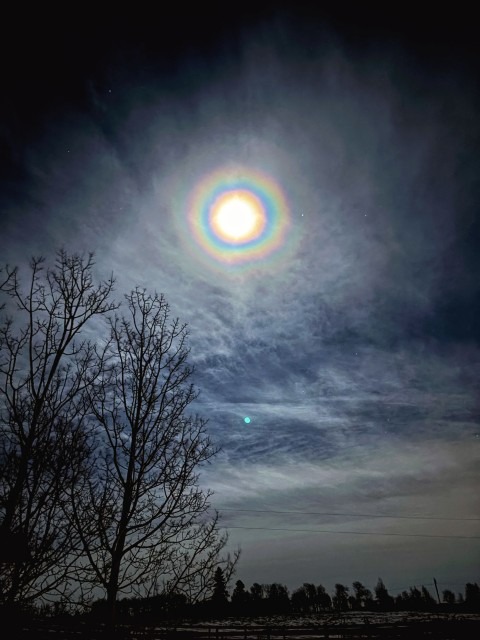
Lisa Harbinson – CC-BY-SA 2024

A classic corona consists of a bright aureole in the center, with one or more colorful rings around it. For the sharpest coronae, the droplets must be all close to the same size, so the interference pattern in the light can be well defined. It is constructive and destructive interference among the scattered light waves, where they add to make bright regions and subtract to make dark regions, that make the alternating rings of bright and dark.

rjb

Posted in Uncategorized | Tagged , , , | 12 Comments

Pery Burge

Photo credit - Pery Burge - click for larger image

Photo credit – Pery Burge – click for larger image

Pery Burge died in 2013, but she left behind a collection of beautiful photographs. Asked how she generated her photographs, Pery Burge said, “I place ink in water, which I photograph . . .” Trust me, there’s a lot more to it than that. In her Artist’s Statement, she said, “In 2011, I began to work with glass and light . . .” That series of photos she called “Lightscapes.” She also has a series called “Smoke.” There’s a series called “Lab Images,” one called “Bubblespreads,” and one containing her personal selections, and many more besides. Finally, you can see tons of her photos on her flickr photostream.

Her website, “Chronoscapes,” has a final journal entry entitled “Pery Burge,” written by a friend shortly after her death. In a sad irony, her own final entry was entitled “Looking Forward to 2013.”

Pery Burge died too young, but she left beauty behind.

rjb

Posted in Uncategorized | Tagged , | 8 Comments

Halo

Image credit - Michael Glanznig - CC-BY-SA

Image credit – Michael Glanznig – CC-BY-SA

1 22°-halo, 2 Parhelia (Sundog), 3 Sun pillar, 4 Parhelic Circle, 5 Circumzenithal Arc, 6 Tangent arcs and Circumscribed Halo, 7 46°-halo, 8 Subsun

Cloud of the Day – Halo

Image credit - Rudy23 - CC-BY-SA

Image credit – Rudy23

Image credit - Andrzej Barabasz - CC-BY-SA

Image credit – Andrzej Barabasz – CC-BY-SA

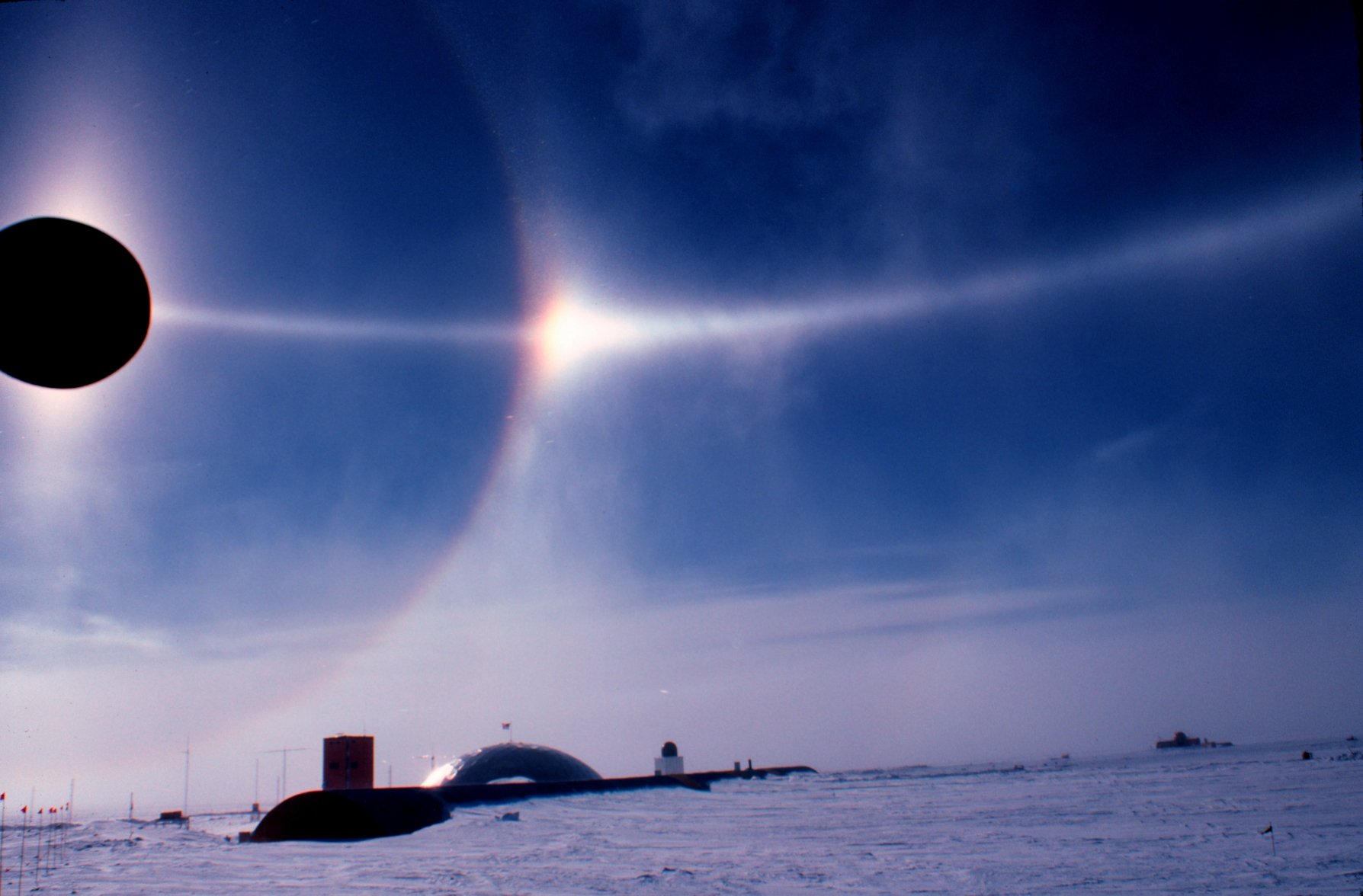
A meteorological halo, also called nimbus, icebow and gloriole, is a product of sunlight or moonlight being refracted by ice crystals in the atmosphere. Although a halo can often be seen around an artificial light, such as a street lamp, the real ones form in cirrostratus clouds 5-10 kilometers above the ground. Due to the refractive index of the ice crystals, the halo forms 22 degrees away from the light source. Sometimes a second one can be seen at 46 degrees. As long as the ice crystals extend far enough and the Sun or Moon is at least 22 degrees above the horizon, the halo is always circular.

Public domain

Public domain

Public domain

Public domain

In addition to their beauty, haloes are also used in weather lore. Since the presence of cirrostratus is often a harbinger of lowering cloud, they can be used to forecast approaching weather.

Lunar

Image credit - Humberto Romero - CC-BY-SA

Image credit – Humberto Romero – CC-BY-SA

Image credit - nuno morao - CC-BY-SA

Image credit – nuno morao – CC-BY-SA

rjb

Posted in Uncategorized | Tagged , , | 1 Comment