Milutin Milankovitch

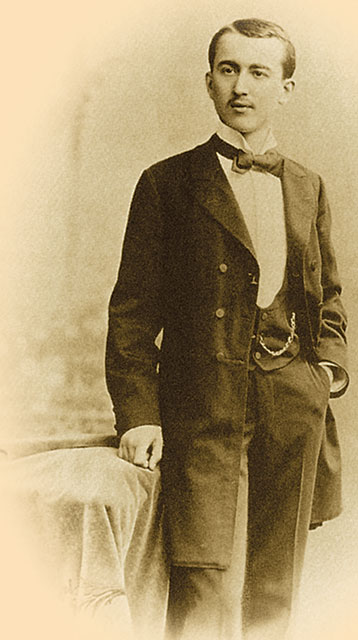
Milutin Milankovitch (Milankovic) was a Serbian scientist, born in 1879 in the village of Dalj, in present-day Croatia. It was then part of the Austro-Hungarian Empire. At 17 he took up Civil Engineering at the Vienna University of Technology, going on to earn a Ph.D in engineering eight years later. His thesis was on pressure curves, useful in the planning and construction of load-bearing structures like bridges. He got work with an engineering firm, concentrating on reinforced and armored concrete, until he was offered the chair of applied mathematics at the University of Belgrade in 1909. He began to concentrate on fundamental research, though he kept his hand in concrete as well.

In his research he became interested in celestial mechanics and astronomical effects on planetary climate. He found that, although scientists were finding convincing evidence of ice ages in Earth’s past, including some indications that they might be cyclical, they were unable to come up with a plausible theory to explain it. He decided to use his interest in astronomy, and his facility with mathematics, to see if he could find any patterns that might explain the cycles in Earth’s climate. He began in 1912, following up on the work of his predecessors in the field, including James Croll, whose pioneering work on astronomical influences on ice ages was rejected by geologists and climatologists of the day. Milankovitch would face the same scepticism.

He began by publishing some papers on the effects of solar radiation, and its distribution on the planet’s surface, bringing some mathematical rigor to the science of meteorology. Then he began the more onerous task of calculating the cyclical variability of the Earth’s rotation on its axis as well as its orbit around the Sun. These eventually came to be called Milankovitch cycles, when everyone finally caught up and realized he was right. I’ll discuss those cycles independently in future posts.

His work was interrupted, though only briefly, by the beginning of World War One. He was imprisoned as a Serbian enemy of the Austro-Hungarian Empire, but was soon released upon the intervention of his friend and mentor, Emanual Czuber. He subsequently was allowed to work at the Hungarian Academy of Science for the duration of the war. After the war he returned to Belgrade where he continued to create the foundation for the mathematical treatment of climate science. He calculated the curve for variations in solar radiation impinging on the Earth going back 130,000 years, extending it to 650,000 years at the urging of climatologist Wladimir Koppen. He also impressed Alfred Wegener, of continental drift fame.

Milankovitch published many more papers, as well as popular science books, including a series on the history of science. The publication of his collected works on the problem of the Ice Ages was interrupted by the Second World War, and it ended up being published in German. It was almost lost in the bombing of Belgrade when the printing house entrusted with it was destroyed. Fortunately the warehouse where the printed sheets were stored was spared.

Milutin Milankovitch died in Belgrade in 1958. After his death his work was disputed and it languished for ten years. But it slowly gained support and is now accepted by most climatologists and geologists as an accurate theory. The Milankovitch cycles have been shown to bear a close relationship with the cycles of the Ice Ages. He shares the honor of being one of Serbia’s great scientists with the legendary Nikola Tesla.

Read the series on Milankovitch cycles, beginning with orbital eccentricity.

rjb

Posted in Uncategorized | Tagged , , , , , | 4 Comments

Evolution – Part Three

Photo by Michael D. Gumert. – CC-BY – No larger image available

Some years ago I published a series of articles about evolution in my local newspaper. It generated some interest and a spate of letters to the editor, and my publisher liked it. There was even a creationist who challenged me to a debate over it. I decided to reproduce it here. This is part three, which I called Walk This Way. See also Part One and Part Two.

The first primates show up in the fossil record about 50-55 million years ago. They are part of the resulting explosion of new species that evolved to fill environmental niches vacated by the non-avian dinosaurs, after they went extinct sixty-five million years ago. Many of the new species are mammals, and we see a mammal-dominated landscape right now. Of the mammals, it is the primates which interest us the most, as they are our ancestors. Primates spread out and evolved into many different species, including lemurs, monkeys and apes. They can be found in most parts of the world, but it was in Africa where the line led to humans.

Between seven and eight million years ago a primate living in Africa split into two species. Such splits normally result when two populations of one species get separated somehow. Something like that happened to the common ancestor of chimpanzees and humans. A fossil from that period shows definite signs of an upright, two-legged gait, but the oldest hominin fossil with extensive bipedal adaptations is Ardipithecus ramidus. That was the beginning of the hominin, or human-like primate. Since then it evolved and radiated out into many different hominin species, most of which have gone extinct.

The first evidence of stone tools shows up at least 2.6 million years ago, with some evidence that pre-homo hominins were using them as early as 3.3 million years ago. Undoubtedly they were using tools made of other materials like wood and grass, but only stone can survive long enough for us to find.

Homo erectus is thought to have tamed fire by about 1.8 million years ago. Others put the use of hearths beginning later, at about 800,000 and even only 300,000 years ago. Much of the discussion revolves around whether we were simply burning grasslands to improve hunting, or actually sitting around a hearth cooking food on a regular basis. Those favoring the earlier date cite the shrinking jaw and growing brain of H. erectus as evidence that they were cooking their food. The pinnacle of upright hominids seemed to have been reached, but their brains were only about half the size of ours. Larger than the brains of similar-sized animals, but still too small by our standards.

Increasing brain size was the next big step. By the time we reach the age of Neanderthals, about four hundred thousand years ago, and modern humans at about half that, our brains were as big as they are now.

Since then it’s been a matter of social and technological evolution. The first jewelry shows up about 75-100 thousand years ago. The first garments appear to have been manufactured about 100 thousand years earlier, based on the evolution of body lice. The tool set became extremely sophisticated.

Neanderthals died out about thirty thousand years ago, leaving only a single hominid species on Earth for the first time in millions of years. Our cultural evolution continued to accelerate, as evidenced by sophisticated cave paintings, bringing us to the present state of high civilization.

Let’s hope we’re not due for another mass extinction.

rjb

Posted in Uncategorized | Tagged , , , , , , , , , | Leave a comment

Evolution – Part Two

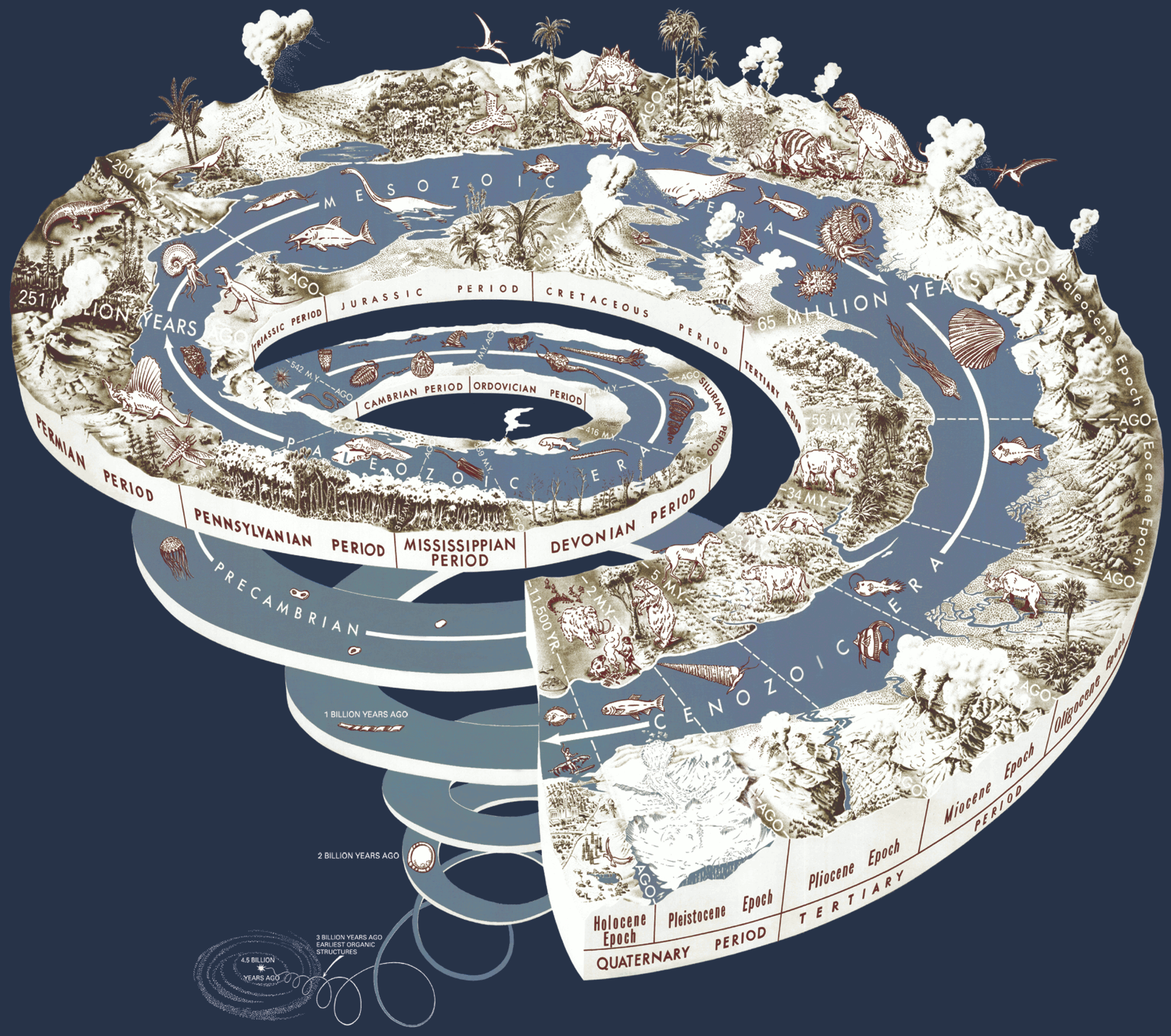
Credit United States Geological Survey – Public Domain – Tap for large original

Some years ago I published a series of articles about evolution in my local newspaper. It generated some interest and a spate of letters to the editor, and my publisher liked it. There was even a creationist who challenged me to a debate over it. I decided to reproduce it here. This is part two, which I called Tough Life. See also Part One and Part Three.

Life started on Earth just about as soon as it could. When the Solar System condensed out of a vast cloud of dust and gas about four and a half billion years ago, Earth was a molten globule. It was kept molten for a few hundred million years by a continuing bombardment of comets and planetoids among the thick debris. Eventually, as fewer collisions occurred, Earth cooled and its crust formed and hardened. It was still so hot that the huge quantity of water delivered by the comets was kept vaporized. Only after about 500 million years had it cooled enough for standing water to form on the surface. Not long after that we begin to see fossils of tiny organisms.

There is a question whether life formed through the evolution of chemistry on this planet, or arose from space-borne particles. Either way it’s been here for almost four billion years. The fact that it took root as soon as it could and has survived for so long both show how tough and persistent life is. It has had to be. There have been at least five major extinctions that we know of in the interim. There were probably more, but we haven’t unearthed the evidence yet. Some of the extinction events extinguished over ninety percent of the species on Earth. Once in a long while everything changes forever.

The first creatures were tiny, simple, single-celled organisms. They didn’t even have a nucleus, their DNA floating freely within the cell. From them evolved more complex forms of life, with DNA in a nucleus and other structures performing ever more complicated tasks. About two and a half billion years ago evolution produced a radical change. A microbe appeared which could use sunlight to synthesize food from water and carbon dioxide. Unfortunately for the existing life forms, the oxygen produced as a byproduct was a deadly poison. Things were changed forever.

About five hundred forty million years ago the abundance of free oxygen provided the energy for another radical change. Multicellular life arrived and proliferated in an explosion of diversity. It was a matter of time before some of it found a way to live on land, away from the competition and sharp teeth in the sea. It wasn’t long, in geological terms, before the land was covered in a riot of life. Evolution filled every niche with a profusion of species, including the majestic dinosaurs. Then the most famous mass extinction happened sixty-five million years ago. Dinosaurs were out and mammals were in.

Life took hold here early and has persisted by evolving and adapting to a state of permanent change.

rjb

Posted in Uncategorized | Tagged , , , , , , , , | 4 Comments