Milankovitch Cycles – Precession


In the two previous posts on Milankovitch cycles — Eccentricity and Obliquity — we looked at the changing shape of Earth’s orbit around the Sun, and the changing tilt of Earth’s axis respectively. In this post we look at the other axial cycle: precession. In addition to changes in the tilt of the axis relative to the plane of our orbit, the direction that the axis is pointing in space changes over time. Over a period of about 26,000 years, it draws a circle on the star field. Presently the north end of the axis is pointing almost directly at Polaris, the pole star. About 13,000 years ago, near the end of the last great glaciation, it was pointing at the star Vega. The spinning planet is wobbling like a spinning top.


The effect of precession on climate is to continuously change where on our orbit the seasons occur. You can imagine that if we were on the opposite side of our wobble’s circle, then our summers and winters would be on the opposite sides of our orbit. Instead of winter in the northern hemisphere occuring during the part of the orbit when we are closest to the Sun, it would be at the farthest away. Northern hemisphere winters would be colder, but summers would be warmer, perhaps preventing the accumulation of ice and snow from season to season. Precession doesn’t affect the tilt of the axis, only where it’s pointing, so we still have seasons and they’re still affected by the obliquity cycle.

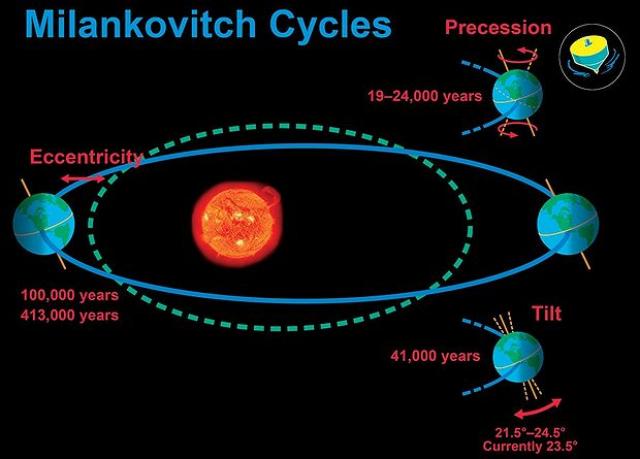
Now we have three cycles interacting: eccentricity at about 100,000 years, obliquity at about 41,000 years, and precession at about 26,000 years. You can see how complex this interaction is, and appreciate the work it took for Milankovitch to untangle it. He was doubted for a time, but these astronomical cycles are now accepted as important drivers of Earth’s climate. They came together to pull us out of the last glaciation, and now they are conspiring to push us into the next one. If we follow the established cycles, we should see a large part of the northern hemisphere’s continents covered in gigantic glaciers in the future.

Next up: some bonus extras.

rjb

Posted in Uncategorized | Tagged , , , , , , , | Leave a comment

Milankovitch Cycles – Obliquity


This is the second of the three main Milankovitch cycles that I said we’d cover in my original post on Milutin Milankovitch. The first cycle was Earth’s orbital eccentricity, or how elliptical the orbit is. We found that this changing eccentricity lays down a base cycle of about 100,000 years. In this post we’ll look at the first of two cycles involving Earth’s axis — obliquity, or axial tilt. It turns out that, while orbital eccentricity might be the dominant cycle, its actual effect on our climate is not the strongest.

Credit Dennis Nilsson – CC-BY.  Tap for slightly larger image.

Everyone knows from their early school years that the tilt of Earth’s axis, 23.5 degrees relative to the plane of our orbit around the Sun, is the cause of our seasons. But how would this affect the climate? Surely it would just continue to put us through the seasons wherever we are on the other cycles, and not contribute anything to the great climatic cycles. That might be the case were it not for the fact that the tilt is continuously changing, oscillating between 22.1 and 24.5 degrees. We are currently about midway, and progressing toward the low end with the least tilt. The entire obliquity cycle takes about 41,000 years.

The effect of axial tilt on long term climate is somewhat complex, but the final outcome is that decreasing tilt leads to a cooler climate. In more detail, a greater angle means that summers are hotter due to more intense insolation, while winters are cooler because the Sun’s rays are more oblique. This effect is strongest at higher latitudes. That’s important because it’s at the higher latitudes where snow and ice accumulation can lead to glaciation, and hotter summers can prevent that. When summers are cooler, snow cover can persist and build up from season to season. That’s especially true in the northern hemisphere where most of the continental land masses are, where snow can increase the albedo.

The amount of tilt to the axis can either add to the effect of the shape of the orbit, or subtract from it. When high tilt (warmer summers) combines with lower eccentricity (generally warmer,) we are at our warmest. When low tilt combines with high eccentricity, we are at our coolest. Tilt was maximum just under 11,000 years ago, when we firmly left the last great glaciation behind. It will reach minimum just under 10,000 years from now, when we should be well into the next glaciation. As we are still very close to the least eccentric, and therefore warmest, part of our orbital oscillation, the deepest part of the next ice age should be one or two obliquities in the future. Even so, these two cycles alone can’t account for Earth’s long term climate, or its ice ages.

We’ll look at the third main Milankovitch cycle, axial precession, in the next post.

rjb

Posted in Uncategorized | Tagged , , , , , , , | 2 Comments

Milankovitch Cycles – Eccentricity


In the post on Milutin Milankovitch I said I would be discussing the Milankovitch cycles and their impact on Earth’s climate. There are three main cycles in Earth’s relationship to the Sun that have been shown to have an effect on the recurring cycles of the Ice Ages. Two of them involve Earth’s axis, and one its orbit around the Sun. In this post, we will look at the eccentricity of Earth’s orbit.

Here’s a graphical view of the cycles:

Credit Incredio – CC-BY-SA. Tap image for large original.

The first thing to realize about planetary orbits, as demonstrated by Johannes Kepler, is that they are not circular. As a first approximation, all orbits are elliptical. They orbit the central body on an oval path, so sometimes the orbiting body is closer, while sometimes it is farther away. In other words, for part of the year Earth is closer to the Sun than it is on the other half of the orbit. Presently, we are at our closest during the part of the orbit where it is winter in the northern hemisphere. It seems quite nice that things would be set up that way, doesn’t it? The part of our planet that has more land and more people is closer to its heat source during the coldest part of the year.

How does this affect our climate, and what is orbital eccentricity anyway? As there is more land in the north and more water in the south, the current regime keeps us a little warmer. Incoming sunlight is reflected more by snow-covered land than by open water. It has a higher albedo. If the great northern continents had more snow cover, as they would in longer, colder winters, they would reflect more sunlight and cool even more. One ingredient for a possible ice age. One component in our current lack of glaciation.

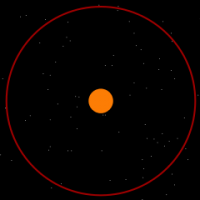
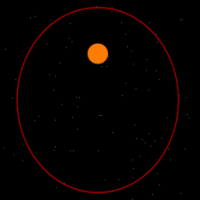
Orbital eccentricity, the Milankovitch cycle in this post, is the name for how elliptical an orbit is. A nearly circular orbit is less eccentric, and a more elliptical one is more eccentric.

The astounding fact is that Earth’s orbit oscillates between more and less eccentric in a 100,000 year cycle. That variability is one of the astronomical factors that Milankovitch calculated in his quest to see if such things could contribute to the ice ages discovered by geologists. Currently the eccentricity is near its minimum — our orbit is nearly circular — with a difference of only about three percent between the smallest and greatest distance from the Sun in a year. This tends to keep us a little warmer. However, the eccentricity is increasing, which should lead to a cooling trend. When the orbit is more elliptical, with the Sun at one focus of the ellipse, the Earth spends more time farther from the Sun, out on the long end of the ellipse. This leads to a gradual cooling trend, contributing to the possibility of accumulating snow and ice. On average during this latest Ice Age, comprising the last few million years, the approximately 100,000 year cycles are roughly 80% cold and glacial, and 20% warm and interglacial.

The 100,000 year cycle in Earth’s orbital eccentricity is the dominant cycle contributing to cooling and warming. The other, shorter cycles make their contribution when they ‘sync’ up with the big one. We’ll talk about those cycles in future posts, beginning with axial obliquity.

rjb

Posted in Uncategorized | Tagged , , , , , , , | 7 Comments