Since the characters in Green Comet have “gecko feet,” I thought it would be good to republish an original article from my erstwhile newspaper column, “Tech Nickels.” This was originally published when biomimetic scientists were first uncovering the marvels of these little creatures’ feet.
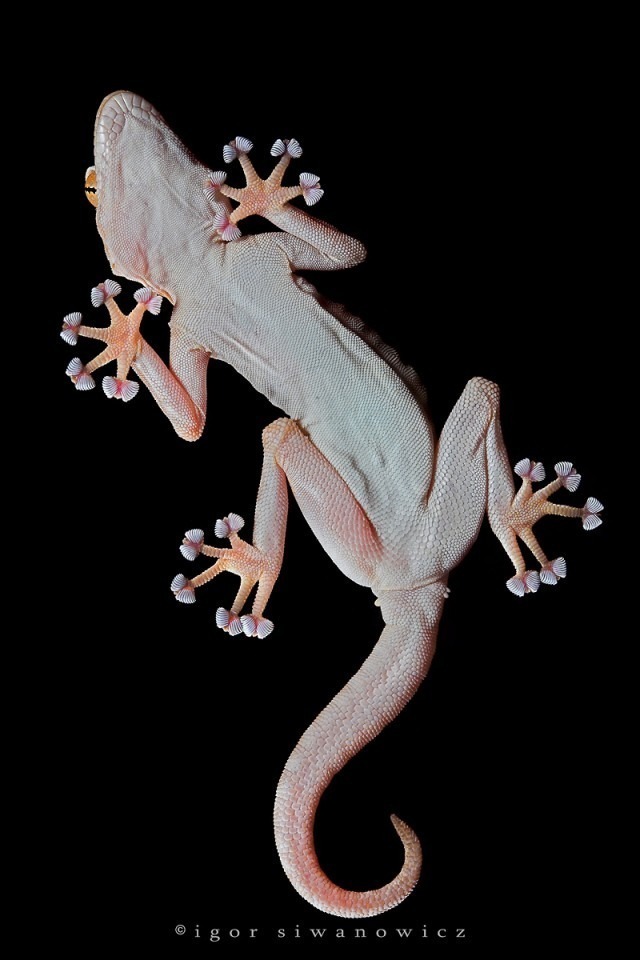
Geckos are small, carnivorous lizards, usually found in the tropics. They work the night shift, eating insects. They’re harmless to humans and are generally welcome in and around homes. An adult gecko weighs about 50 grams, or about as much as a small box of tea.
A gecko can run across a dusty road and straight up a wall. Its feet are so sticky that it could hang from smooth glass by one toe. People have been amazed by the phenomenon for millennia and have been trying to figure it out for as long. We know now that the answer is in the gecko’s hairy feet.
Each of its four feet has about five hundred thousand hairs which can be seen with an optical microscope. But the real secret is smaller than that; smaller than the wavelength of light even. An electron microscope shows that the end of each hair has hundreds of smaller hairs, each tipped with a flat pad. These structures are so small that they can take advantage of the force binding the wall’s molecules together.
It doesn’t use suction or hooks or sticky goo. Unlike suction, as used by salamanders, gecko feet can stick without a pressure differential. Without hooks or grapples, as used by cockroaches, gecko feet can stick to surfaces too smooth to be hooked or grabbed. Without glue, as used by snails, gecko feet stick wet or dry. The little pads on the little hairs covering the contact surfaces of a gecko’s fantastic feet are so small that they can squeeze into the little bubbles of van der Waal’s force around the atoms and molecules in whatever surface they’re on.
Wouldn’t that be great for hanging a picture? I don’t mean using a gecko to stick it to a wall. That would be inconsiderate of the gecko. I mean manufacturing a kind of tape that could be used repeatedly. And since the combined adhesion of all of its feet would hold up a gecko the size of a large hockey player, such a tape would have many uses. It would certainly hold on a car fender, for instance.
Naturally this hasn’t gone unnoticed. A recent branch of science called “biomimetics” devotes itself to learning how it’s been done in nature and seeing if it’s possible to mimic in the laboratory. In the case of gecko feet, they’ve done quite well. So far their gecko tape can support a little more than the real thing.
When something new appears like this, it’s tempting to try to guess where it will show up in the day-to-day world. In medicine? On rock climbers? It will probably inspire a new razor. These things usually do.
See the companion post on spider feet.
rjb