Free Speech

Usually spoken of as Freedom of Expression now, to emphasize that more than actual “speech” is protected, Free Speech is still a source of much confusion. Here is a blog that highlights and clears up some of the problems. Essentially, the problem is that some people think Free Speech means that they should be free of criticism for what they say. I’ll let the Popehat post do the talking. Caution: their language is slightly more salty than what I use here. Not bad, but be warned. Here are a couple of quotes to whet your appetite.

Popehat blog logo

“Only weaklings, cowards, and fools seek protection from criticism of their speech.”

“If you start talking about a ‘right to freely voice thought without the fear of public scorn,’ expect nothing but contempt.”

rjb

Posted in Uncategorized | Tagged | Leave a comment

A World of Villages?

3D printing and fabrication, known informally as “fabbing,” has the potential to be one of the most disruptive technologies ever. 3D printing is the process whereby physical objects are built up in layers in a machine that resembles an ink-jet printer. The design for the object is in a computer file which the printing machine uses to fabricate it. The only other requirements are the “ink,” or the stocks of materials from which the object will be made, and power to run the machine. This technology will allow manufacturers to “print” the parts they need as they need them. It will also allow ordinary people to fabricate things for themselves. People will be able to make things or acquire them locally, instead of having to find a distant manufacturer to send them one. That will have profound effects on the way we do things.

The industries that are dependent on the present way of doing things will suffer, and the result will be a long struggle to prevent the change. Much of the war will be fought with Imaginary Property (IP,) much as the legacy entertainment industry is doing now with music and movies. 3D printing, though, won’t be attacked only by copyright. It will also be vulnerable to the misuse of patents. This topic is covered well in a paper titled “It Will be Awesome if They don’t Screw it up,” by Michael Weinberg.

People aren’t letting these threats dampen their enthusiasm, though. Fabbing is an energetic and rapidly growing field, led by the likes of MakerBot and RepRap. For them it’s full speed ahead now and we’ll deal with the problems when they arise. I hope that doesn’t make them easy pickings for the people who won’t want to see them succeed.

What about the title of this post, “A World of Villages?” I was just wondering what would happen as at least some of our manufacturing processes become decentralized. If most of the things we need can be fabricated locally instead of being made in big factories far away, might we not find ourselves thinking locally more? Might we not find ourselves in villages once again?

rjb

Posted in Uncategorized | Tagged | Leave a comment

Spider Feet


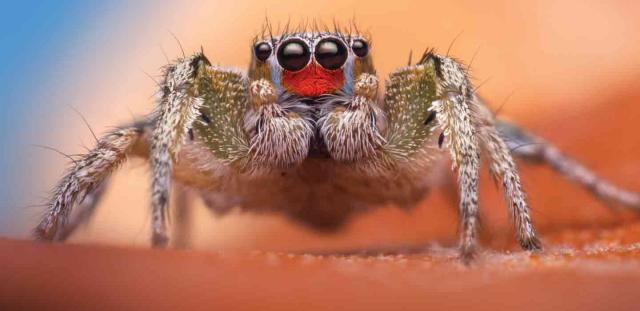
Edit: See below for more on the eyes of jumping spiders.

Geckos aren’t the only animals that use van der Waals force to stick to the ceiling. Scientists in Germany and Switzerland have been using electron microscopes to look at the feet of jumping spiders. There they’ve found the same hairs-covered-by-hairs combination that gecko feet have. Once again the hairlets are so small that they can fit into the force fields around molecules and stick fast. Calculations show that the total sticking power of their feet could theoretically hold 173 times their weight.

The jumping spiders – hunters, not web builders – have an added twist to their use of van der Waals force fields. They don’t simply make passive use of the force. The structure of the setules, the smaller hairlets on their feet, allows their van der Waals forces to combine into a very strong overall force on each foot. The spiders are producing their own adhesion, not just making use of the existing forces in the ceiling.

Like geckos, jumping spiders can stick to the ceiling even if it’s wet or oily, no matter how smooth it is. That’s because the setules and the molecules of the ceiling meet in spaces so small that concepts of roughness and wetness simply don’t compute.

This research opens up interesting possibilities for adhesives. Dry, all-purpose, all-weather, reusable duct tape comes to mind.

Jumping spiders sound like the nightmares of the small world. Unlike some other species of spiders, which can have their eight eyes arranged all around their heads, hunting spiders tend to have theirs clustered on the front. All the better to focus on their prey, I imagine. Some of them also bungee jump. They go after flying prey, including birds for some larger spiders, by jumping into the open air. If they miss they haul back up the strand of web to where it’s attached at their launch site and wait for the next meal on wings.

All this and sticky feet, too. Their ability to cling to any surface, focus acutely on moving objects and jump great distances add up to an extremely efficient hunter. It makes you wonder if any of them hunts geckos. Hunter and prey running across the same molecular force field.

rjb

Edit: More information on the kind of vision jumping spiders have in their eight eyes.

Credit Science News

The principal eyes — the big forward-facing ones that just beg us to anthropomorphize — have incredibly high resolution for creatures that are usually between 2 and 20 millimeters long. Their eyesight is sharper than any other spider’s and is the secret behind their ability to stalk and pounce on prey with impressive precision. Their sight is comparable to that of much larger animals like pigeons, cats and elephants. In fact, human visual acuity is only about five to 10 times better than a jumping spider’s.

Follow this link to a Science News article about the fascinating visual world of jumping spiders.

rjb

Posted in Uncategorized | Tagged , | Leave a comment