Halo

Image credit - Michael Glanznig - CC-BY-SA

Image credit – Michael Glanznig – CC-BY-SA

1 22°-halo, 2 Parhelia (Sundog), 3 Sun pillar, 4 Parhelic Circle, 5 Circumzenithal Arc, 6 Tangent arcs and Circumscribed Halo, 7 46°-halo, 8 Subsun

Cloud of the Day – Halo

Image credit - Rudy23 - CC-BY-SA

Image credit – Rudy23

Image credit - Andrzej Barabasz - CC-BY-SA

Image credit – Andrzej Barabasz – CC-BY-SA

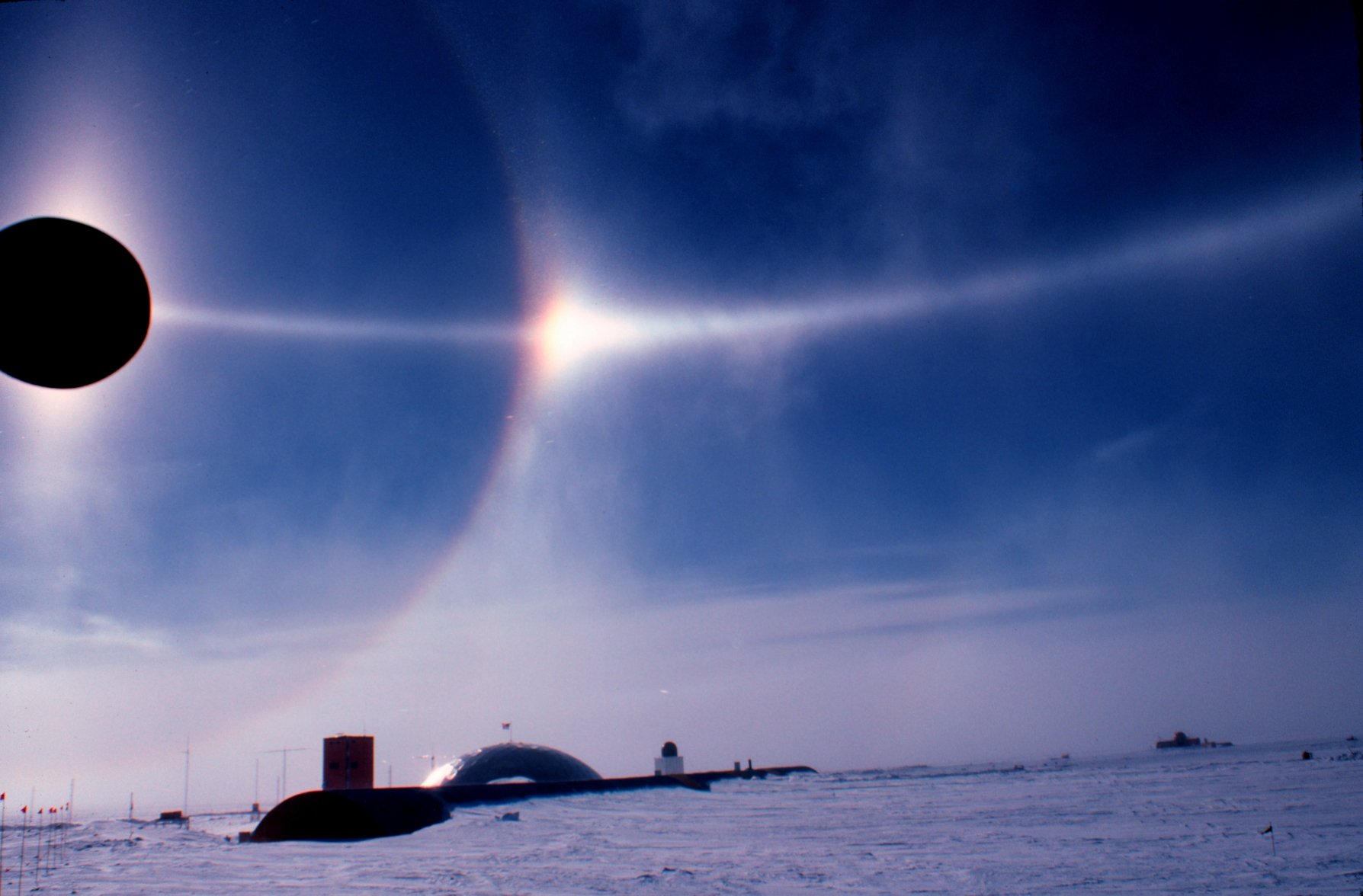
A meteorological halo, also called nimbus, icebow and gloriole, is a product of sunlight or moonlight being refracted by ice crystals in the atmosphere. Although a halo can often be seen around an artificial light, such as a street lamp, the real ones form in cirrostratus clouds 5-10 kilometers above the ground. Due to the refractive index of the ice crystals, the halo forms 22 degrees away from the light source. Sometimes a second one can be seen at 46 degrees. As long as the ice crystals extend far enough and the Sun or Moon is at least 22 degrees above the horizon, the halo is always circular.

Public domain
Public domain

Public domain

Public domain

In addition to their beauty, haloes are also used in weather lore. Since the presence of cirrostratus is often a harbinger of lowering cloud, they can be used to forecast approaching weather.

Lunar

Image credit - Humberto Romero - CC-BY-SA

Image credit – Humberto Romero – CC-BY-SA

Image credit - nuno morao - CC-BY-SA

Image credit – nuno morao – CC-BY-SA

rjb

Posted in Uncategorized | Tagged , , | 1 Comment

Alzheimer Precursor

Public domain

Public domain

Is this a precursor to Alzheimer Syndrome?

Researchers at the University of Eastern Finland have found a correlation between cynical distrust and a higher diagnosis rate for Alzheimer disease later in life. There seems to be a link between cynicism – assuming the worst about the motives of others – and dementia. So is it safe to say that cynical distrust is an Alzheimer precursor? Maybe. Then, can we say that cynicism causes dementia? No. Correlation is not causation. The fact that cynicism and distrust of others seems to be an Alzheimer precursor does not mean that it causes it, as the researchers were careful to point out.

Public domain

Public domain

It’s possible that cynicism is just one trait of an overall ‘negative’ personality, and this is another example of attitude affecting health. It may be part of a personality type that makes a person less likely to lead a healthy life. It could even be that the distrustful trait is one of the early signs of dementia, and that the causation goes the other way. The researchers stress that their small study is not definitive. They’re hoping that other, larger studies will be conducted to clarify the matter.

dementia

Even though this correlation is not definitive, previous studies have shown a link between cynical distrust and other problems, such as coronary disease. So the message is to lighten up. Negative thoughts can make you sick.

rjb

Posted in Uncategorized | Tagged , , , , , , | 5 Comments

Crepuscular Rays

Photo credit - Brocken Inaglory - CC-BY-SA

Photo credit – Brocken Inaglory – CC-BY-SA

Cloud of the Day – Crepuscular Rays

Isn’t it odd that one of the most beautiful meteorological phenomena has the ugliest name – crepuscular rays? Or is it just me? Maybe the word “crepuscular” sounds beautiful to most people. According to The Free Dictionary, the word comes from the Latin crepusculum, which means twilight. As such, crepuscular also refers to animals that are primarily active during twilight. That includes dawn or dusk, bright moonlight and dim days. For our purposes here though, it’s crepuscular rays, sometimes called God rays, of course.

Crepuscular rays are rays of sunlight that stream through gaps in clouds or other objects, so you get alternating bright shafts of light and darker shadows. The shafts of sunlight glow due to the presence of water or other material in the air which reflects the light. Since these effects tend to show up best around dawn or dusk, the crepuscular hours, they’ve been named crepuscular rays. Although the rays are nearly parallel, they appear to radiate from a point due to the effects of perspective, much the way parallel railfoad tracks appear to converge in the distance.

As you can see from the pictures, crepuscular rays are associated not only with clouds, but also in any circumstances that allow the formation of alternating light and shadow, and something to highlight the shafts of light. You can even see the shadows from above in the picture taken from the International Space Station. You can click on the pictures to see larger images. Here are links to the original, really large copies.

1, 2, 3, 4, 5, 6.

rjb

Posted in Uncategorized | Tagged , | 2 Comments