Some Women See a Hundred Million Colors

An unknown percentage of women can see a hundred times as many colors as the rest of us. While normal humans have three types of cones in their eyes for perceiving the three primary colors — red, green and blue — some women have an extra cone that gives them four primary colors. Most of us can theoretically distinguish a million colors. These women can see a hundred million colors.

Tetrachromatic women have a strong relationship to color-blind men. How does a deficiency — color-blindness — relate to this increased color perception? It has to do with the X chromosome and the fact that the genes for color perception reside on the two sides of it. With only a Y chromosome, and missing one of the arms of the X chromosome, men have less chance for redundancy. If they have a mutation in a color gene it usually means some loss of color perception. Women related to these men will likely have the same mutation, but they will have redundant genes on the second arm of their X chromosome. So the men will be down to two functioning cones, but the women will still have all three, plus the mutated one, which might still provide some color.

More recent research indicates that we might all be tetrachromatic after all. It turns out that parts of our optical system absorb the shortest wavelengths of the light that passes through them. It was assumed that our vision cut off at about 400 nanometers — blue — but it’s been discovered that the higher blues and the ultraviolets are being absorbed by our corneas and lenses. People who have their lenses removed in cataract surgery often report a new sensitivity to very short wavelengths.

Recently the BBC made a tetrachromatic woman famous. Concetta Antico is an artist and she can see colors that most of us can’t even imagine.

Some women are born with hyper-sensitive eyes that can see the world in ways most of us cannot even imagine. What’s it like to live with this gift?

Source: BBC – Future – ‘I see colours you cannot perceive or imagine’

This led to an Internet spasm, of course, and tetrachromacy became all the rage. There were even websites set up that purported to test you for the condition. Soon thousands were reporting on their social networks that they were tetrachromats. Fortunately, Snopes came to the rescue and showed quite simply why they were wrong. Computer monitors only use three colors so they can’t possibly test you for four. The Snopes article refers to Newcastle University’s tetrachromacy research project and credits them in debunking the Internet fad. Newcastle University has a FAQ on their research.
newcastle-tetrachromacy-project

When I look out the window and see all the shades of green and brown in my back lawn, it’s hard to imagine that I’m not seeing it all. Learning that some people can see a hundred times as many shades makes me think about how little of reality I’m really seeing.

rjb

Posted in Uncategorized | Tagged , , , | 22 Comments

Concerns About Self-driving Cars

Speaking of self-driving cars, federal legislators in the US are getting their hands in. They didn’t take long to get onto their concerns about security and safety. They’re concerned about hackers and cybersecurity. What if someone takes control of one or more cars as they’re hurtling down the freeway? What happens the first time someone dies due to an error by the artificial intelligence controlling the car? As I noted in this Green Comet post, that will be more significant for most people than the ten thousand lives the AI saves. What about the inevitable situation where one or more cars find themselves in a situation where they have to decide who will survive and who will die? Self-driving cars are operating now, and it won’t be long before we begin to see them everywhere. This is going to raise some technical, ethical and practical issues. It’s going to be interesting.

With a demonstration of vehicles from BMW, GM, and Tesla on Tuesday, self-driving cars made a splash in Congress. But some lawmakers expressed concerns about the safety and security of autonomous vehicles as federal regulators mull creating a unified standard.

Source: Why concerns about self-driving cars may require a more hands-on approach

rjb

Posted in Uncategorized | Tagged , , , | Leave a comment

Driving While Under the Influence of a Phone

Credit Melissa Wenger - Public Domain

Credit Melissa Wenger – Public Domain

Imagine driving into town. Your cell phone beeps and you take the call on your hands-free headset. You’re flagged down by the police, fined, have your driving privileges revoked and your car impounded. That’s what they do when you drink and drive. But you weren’t drinking, you just used your phone.

It used to be hard to imagine being arrested for driving and phoning. In spite of the evidence that driving while under the influence of a phone is equivalent to drinking and driving, we don’t want to give up our right to be talking. If only we could find a way to do it without having our driving impaired.

Credit Smallman12q - CC-BY

Credit Smallman12q – CC-BY

How impaired is it? According to a National Safety Council article, an estimated one in four crashes involves cell phone use. In tests on driving simulators, subjects who used the phone deteriorated just as if they were legally intoxicated. Their mistakes increased and their reactions slowed. This was regardless of whether the phone was handheld or hands-free. The problem is not just that your hands are busy. There’s something in the telephone conversation itself that affects one’s ability to drive safely.

Part of the problem is the simple act of trying to multitask, according to a New Atlantis article on the myth of multitasking. The way we do that is by switching back and forth among the tasks, because we can’t do everything at once and do any one thing well. The act of switching between tasks takes time; our brains just can’t do it instantly. The result is that we end up spending a lot of time between tasks, not attending to any of them.

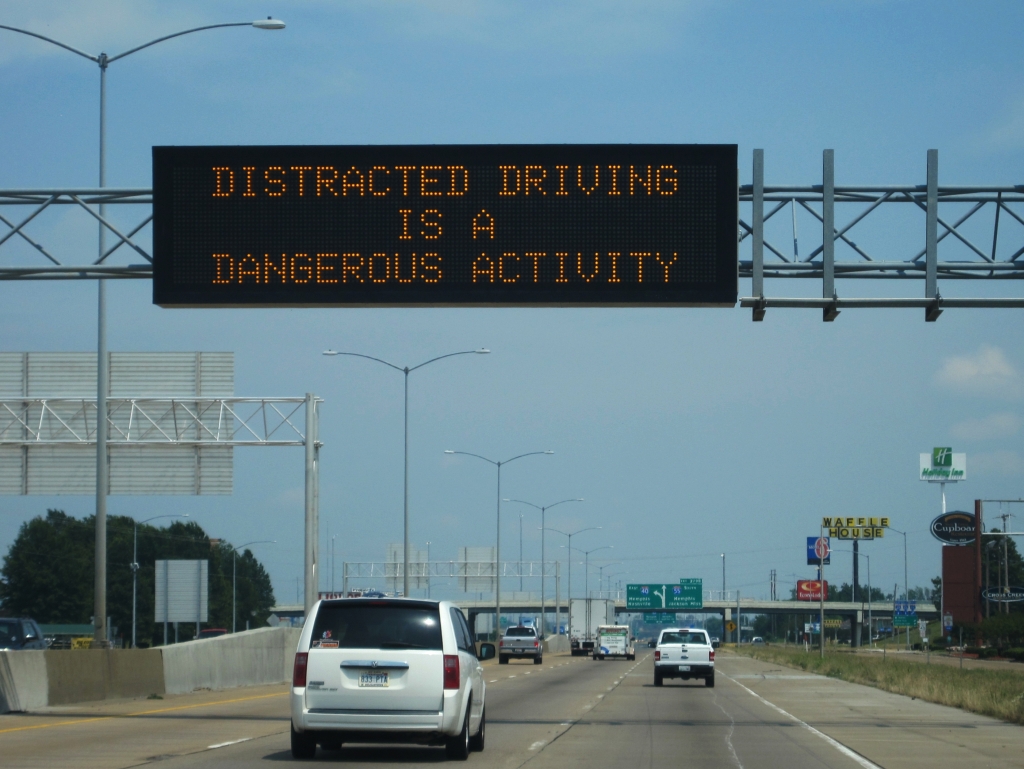
Credit - Thomas R Machnitzki - CC-BY - Is that sign ironic?

Credit – Thomas R Machnitzki – CC-BY – Is that sign ironic?

From the New Atlantis:

Multitasking might also be taking a toll on the economy. One study by researchers at the University of California at Irvine monitored interruptions among office workers; they found that workers took an average of twenty-five minutes to recover from interruptions such as phone calls or answering e-mail and return to their original task. Discussing multitasking with the New York Times in 2007, Jonathan B. Spira, an analyst at the business research firm Basex, estimated that extreme multitasking — information overload — costs the U.S. economy $650 billion a year in lost productivity.

Another problem is that we tend to give a lot of attention to conversation. It’s an important aspect of our lives. Our brains automatically give it a high priority. That means there’s less attention available for driving.

Many countries have enacted legislation on cell phones in cars. It ranges from an outright ban on using one in a moving vehicle to allowing unlimited usage, but penalizing the phone user if there’s an accident. Legislators won’t be able to ignore the statistics. They’ll have to come up with some kind of response to the growing damage, injury and death caused by phoning and driving. Let’s hope it solves the problem without taking away our phones. The solution might be hands-free driving.

rjb

Posted in Uncategorized | Tagged , , , , | 6 Comments