Scientists are still making novel discoveries in the Amazon jungle. There’s still plenty to learn, even about ants. Two species of ant discovered recently have evolved in intriguing ways. The first species is interesting for its horticultural practises.
There are areas in Amazonia where almost nothing grows except one species of tree, Duroia hirsuta. It’s much shorter than surrounding trees, being only a few meters tall. These strange patches, as much as a few hundred meters wide, look like orchards. They look as if someone has cleared the forest and planted this one type of tree.
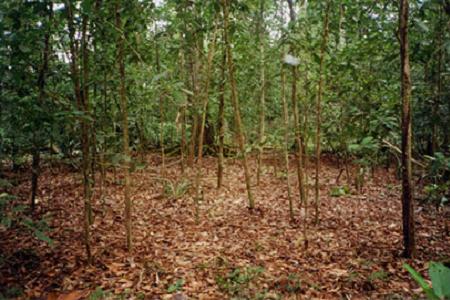 The local people know they didn’t do it and they didn’t see anyone else do it. The effect is apparently so spooky that local legends call the sites devil’s gardens, attributing their existence to an evil spirit. It’s not evil spirits, though, but ants that are responsible for the devil’s gardens. A species of ant called Myrmelaschista schumanni lives in the hollow stems of the D. hirsuta trees and they destroy all the competition. They rely on their host trees for shelter and food and they take extreme measures to protect them.
Their strategy is very successful. Some of the oldest gardens are calculated to be over 800 years old. The millions of worker ants kill the unwanted plants by injecting formic acid into their leaves. The researchers showed it was the ants by planting other species of trees and then protecting some and not others. The unprotected ones started to die within a day while the protected ones survived. This quashed the competing hypothesis which held that the D. hirsuta was inhibiting the growth of other plants by releasing chemicals.
The other ant species (Cephalotes atratus) is interesting because of its gliding ability, even though it doesn’t have wings.
The research in this case was on mosquitoes and the researchers were thirty meters up in the forest canopy waiting to get bitten. Ants, going about their normal business, encountered the humans and naturally attacked to protect their territory. When they were brushed off, instead of just falling they were seen to glide back to the tree trunk. They might bounce off once but they would glide back in again and most of the ants would get back safely to the tree. The researchers concluded that the ants were using their flared heads to glide.
 Ants join the list of species capable of wingless flight. Like flying squirrels, lizards, frogs and snakes, these ants have evolved the ability to maneuver in the air even without wings.
rjb