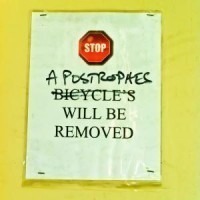
Apostrophe

Credit Graham Horn - CC-BY-SA

Credit Graham Horn – CC-BY-SA

Grammar of the Day – Apostrophe

note: Dana Sallow kindly recommended another grammar website that they found both amusing and useful to them as a non-native English speaker. (See their comment below) The issue covered in this post from a Website Planet blog by Joshua Bromley is homophones. That is, words that sound alike but have different meanings.

Okay, so it’s really punctuation. I’m using it anyway.

The way the apostrophe is being used today has me nervous, afraid this sentence might turn out like this: The way the apostrophe i’s being used today ha’s me nervou’s, afraid thi’s sentence might turn out like thi’s. Sometimes it seems as if people just throw one in if the word ends in an ‘s.’

Credit Dirk Ingo Franke - CC-BY

Credit Dirk Ingo Franke – CC-BY

Granted that’s a bit extreme. But it’s not completely ridiculous. Just look at the epidemic of apostrophes happening now, especially on the Internet. Possibly the worst example is the use of an apostrophe to denote plurality. You see it everywhere, even in places where you’d least expect it. I frequent a forum called MobileRead. It’s populated by people who read. A lot. They love reading. They love talking about reading. They love writing about reading. And I often see sentences like, “How many book’s did you read last year?” there. I’m only slightly mollified by the fact that for many of the people there, English is not their first language. That only means that we’re starting them off on the wrong foot.

remedys
In my own town there’s a drug store called “Remedy’s.” So far I haven’t met the proprietor, Mr Remedy. I suspect he resented English class in school.

Here are a couple of links to the Quick and Dirty Tips website. One on the history of the apostrophe, and the other on when to use an apostrophe. Spoiler alert: the history of the apostrophe is not entirely rational. I wouldn’t be surprised if it eventually became okay to use it for plurals. Plural’s? In fact, the posts above have examples of where we used to use them for some plurals, but don’t now. And where we still do use them for special plurals. It’s no wonder people get confused. And some get even.

Grammar is evolving. What is correct now was not always correct. What is correct in one place is not necessarily correct everywhere. But that is no excuse for not using what is correct here and now.

March 4th is National Grammar Day (America.)

rjb

Posted in Uncategorized | Tagged , , | 3 Comments

Does mental illness enhance creativity?

Here’s another of my pet peeves: The pop psychology link between creativity and mental illness. It is so ingrained that it is assumed to be true, and its proponents are often struck dumb when you question it. If you ask for evidence they refer to cultural phenomena. The obviousness of this artist’s unbalance, or that musician’s early death. They never refer to the thousands of artists who happily played croquet with their families on sunny afternoons. Or the many musicians who died of old age after long, successful careers. That’s not as interesting, is it?

From the BBC article:

Does mental illness enhance creativity? It’s widely held that it does – but what does the evidence say?

Everyone can cite famous people from Vincent Van Gogh and Virginia Woolf to Tony Hancock and Robin Williams, who were exceptionally creative and experienced mental health problems. There are so many examples that it seems obvious that there must be a link between mental illness and creativity.

In fact there is remarkably little good data on the topic.

One of the difficulties is that it isn’t very easy to define or measure creativity, so researchers often use proxies for it. For example, a study from 2011 simply classifies people by occupation assuming that everyone who is an artist, a photographer, a designer or a scientist must be creative, regardless of their exact job.

Did the supposed creative benefits of bipolar disorder make the writers more likely to choose their profession or did the symptoms mean it was harder for them to find a traditional job? It is hard to know.

So when the evidence is thin at best and according to some studies, lacking altogether, why has this idea stuck?

There could be many reasons why we find the idea so attractive. Maybe it reassures non-creative people, who can congratulate themselves that at least they’re not crazy. Maybe it serves as compensation for some people suffering with mental illness. At least they might be compensated with creativity. Maybe it’s just a really sexy idea that we love to perpetuate. It certainly makes for an easy cliche to use in books and movies.

Something to keep in mind:  Plenty of non-creative people have psychological problems, too.

Check out the BBC article for more.

Source: Does mental illness enhance creativity?

rjb

Posted in Uncategorized | Tagged , | 1 Comment

I ♥ Free Software – Valentine’s Day 2016 – FSFE

I love Free Software

Valentine’s Day is the day to show our love for Free Software, and for the people who give it to us.

Free Software drives a huge number of devices in our everyday life. It ensures our freedom, our security, civil rights, and privacy. It enables everyone to participate in a fair society. But as with people, everybody has different reasons to love Free Software. Let’s show this variety to the world!

I love Free Software.  Pass it on.

Source: I ♥ Free Software – Valentine’s Day 2016 – FSFE

rjb

Posted in Uncategorized | Tagged , , , | Leave a comment