Evolution – Part Two

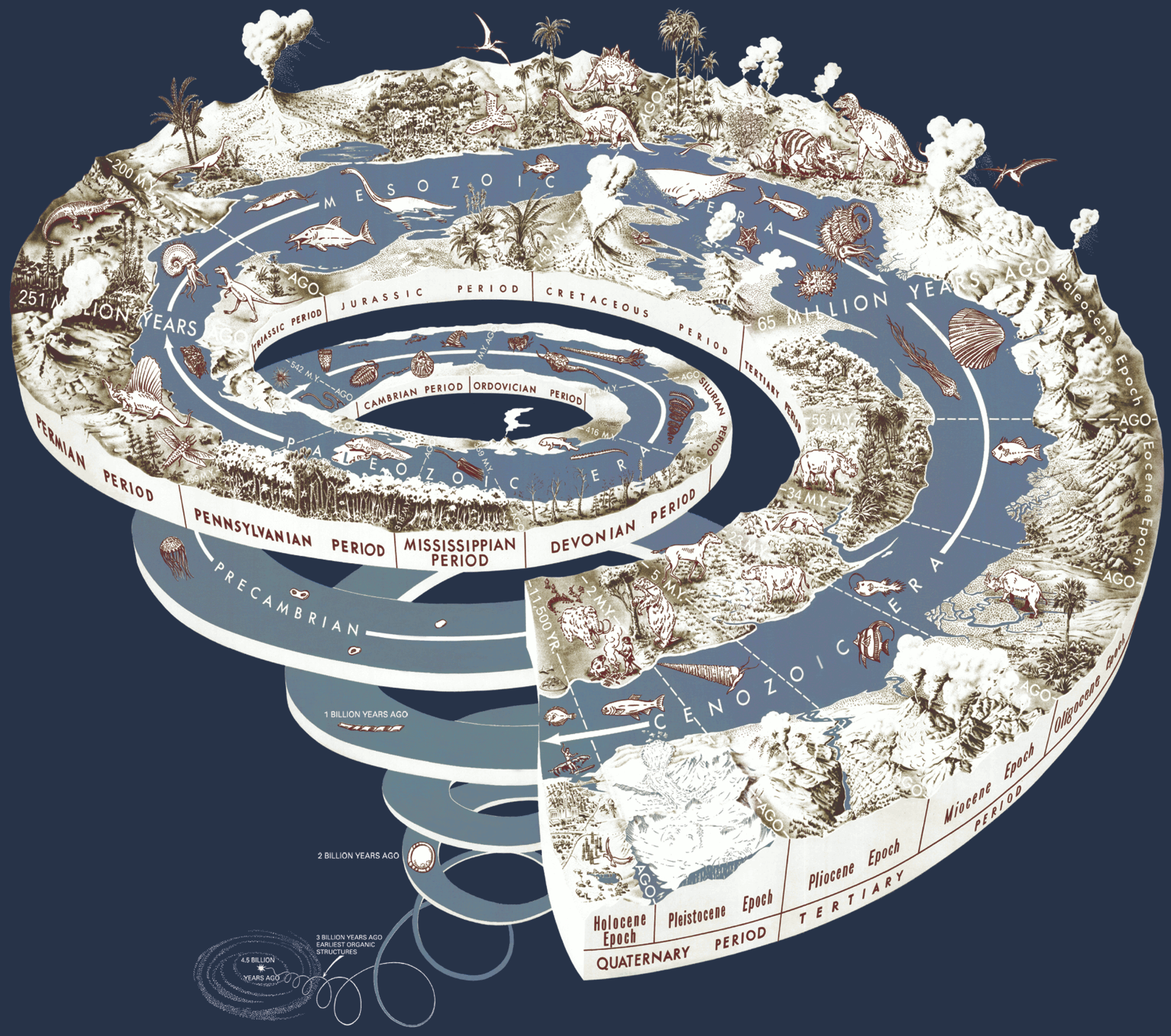
Credit United States Geological Survey – Public Domain – Tap for large original

Some years ago I published a series of articles about evolution in my local newspaper. It generated some interest and a spate of letters to the editor, and my publisher liked it. There was even a creationist who challenged me to a debate over it. I decided to reproduce it here. This is part two, which I called Tough Life. See also Part One and Part Three.

Life started on Earth just about as soon as it could. When the Solar System condensed out of a vast cloud of dust and gas about four and a half billion years ago, Earth was a molten globule. It was kept molten for a few hundred million years by a continuing bombardment of comets and planetoids among the thick debris. Eventually, as fewer collisions occurred, Earth cooled and its crust formed and hardened. It was still so hot that the huge quantity of water delivered by the comets was kept vaporized. Only after about 500 million years had it cooled enough for standing water to form on the surface. Not long after that we begin to see fossils of tiny organisms.

There is a question whether life formed through the evolution of chemistry on this planet, or arose from space-borne particles. Either way it’s been here for almost four billion years. The fact that it took root as soon as it could and has survived for so long both show how tough and persistent life is. It has had to be. There have been at least five major extinctions that we know of in the interim. There were probably more, but we haven’t unearthed the evidence yet. Some of the extinction events extinguished over ninety percent of the species on Earth. Once in a long while everything changes forever.

The first creatures were tiny, simple, single-celled organisms. They didn’t even have a nucleus, their DNA floating freely within the cell. From them evolved more complex forms of life, with DNA in a nucleus and other structures performing ever more complicated tasks. About two and a half billion years ago evolution produced a radical change. A microbe appeared which could use sunlight to synthesize food from water and carbon dioxide. Unfortunately for the existing life forms, the oxygen produced as a byproduct was a deadly poison. Things were changed forever.

About five hundred forty million years ago the abundance of free oxygen provided the energy for another radical change. Multicellular life arrived and proliferated in an explosion of diversity. It was a matter of time before some of it found a way to live on land, away from the competition and sharp teeth in the sea. It wasn’t long, in geological terms, before the land was covered in a riot of life. Evolution filled every niche with a profusion of species, including the majestic dinosaurs. Then the most famous mass extinction happened sixty-five million years ago. Dinosaurs were out and mammals were in.

Life took hold here early and has persisted by evolving and adapting to a state of permanent change.

rjb

Posted in Uncategorized | Tagged , , , , , , , , | 4 Comments

Evolution – Part One

Credit Steinhöfel-ESO - CC-BY

Credit Steinhöfel-ESO – CC-BY – Depicting the evolution of a main sequence star – tap for large image

Evolution: A gradual process in which something changes into a different and usually more complex or better form. The Free Dictionary, definition 1(a).

Some years ago I published a series of articles about evolution in my local newspaper. It generated some interest and a spate of letters to the editor, and my publisher liked it. There was even a creationist who challenged me to a debate over it. I decided to reproduce it here. This is part one, which I called Evolving in Spite of Us. See also Part Two and Part Three.

When we think of evolution we usually think of life. It seems natural to think of Darwin’s “origin of species” as being what evolution is all about. After all, that’s what people are usually talking about when they talk about evolution. It’s good to remember, though, that not only life evolves. Pretty well anything you can think of is changing over time. Everything is in the process of transforming from one state to another. Since that’s practically the definition of evolution, it’s safe to say that everything is evolving.

For example, the interior of our planet Earth is gradually cooling over the eons. That means that there is less heat energy to drive the movement of the crustal plates, and therefore continental drift will gradually slow down. Eventually, if given enough time, Earth would cool enough to set and the continents would never move again. Fewer earthquakes. Fewer volcanoes. Less mixing of the various parts of the biosphere. The Earth is evolving.

Our Sun is also evolving. It’s much hotter now than it was when it was young. It’s been slowly heating up in the four-and-a-half billion years since it was born. If it follows the course of other stars of similar mass and composition, and there’s no reason why it shouldn’t, in another four or five billion years it will be a red giant. This will likely happen before the Earth can cool down enough to set. By that time it will have burned Earth to a crisp, possibly even growing large enough to engulf it. Life on Earth has been adapting to the Sun’s increasing output, even to the point of actively adjusting the atmosphere to keep it in the right temperature range. Nothing is likely to compensate for being engulfed, though.

Even the universe as a whole is evolving. We can tell that it’s expanding, which implies that it used to be smaller. We know that the universe was different in the past, to the point where there were no galaxies or stars at all. In the past it was very small and very hot. After about 14 billion years of expansion it exists in a state which supports life. Unfortunately, the rate of expansion is increasing. If nothing happens to change things, the universe is going to grow increasingly cold and dark. Eventually it will no longer support life.

We may continually come back to life when we think of evolution, but evolution goes on regardless of life.

rjb

Posted in Uncategorized | Tagged , , , , , , | 4 Comments

Fake News – Fake Science

fake-news-everything-on-realtruenews-was-a-lie

Fake news is in the news these days. It’s a problem because of the gullibility and credulousness of so many people. There are those who trust any source that gives the appearance of authority. And there is the ever-present problem of people believing anything that seems to confirm their biases, either supporting what they believe, or criticizing what they dislike. This is pretty bad but normally it wouldn’t be much of a problem. Just another case of liars taking advantage of fools. But this time around it is out there in such volume, and is said to have so much influence, that people are rightfully beginning to worry.

But that’s just the news. At worst, we might have to put up with foreign countries or malevolent corporations affecting democratic elections. Oh, and the disenfranchisement of voting citizens. And I guess the serious erosion of trust in democratic institutions and processes. But that’s just politics, right? There’s always been lying and cheating there. No, the really worrisome fakery is taking place in science. Just as there is an increase in fake news, so there is an increase in fake science.

We’re used to corporations and their loyal politicians invoking false or purchased science to protect their profits and privileges. From tobacco to fossil fuels, we’ve been repeatedly reassured that no one has proven that they’re harmful. So maybe people die, or the environment suffers, but that’s just business as usual. We’re used to it. There’s never been a question about the integrity of the scientific community. Just a few individuals who weren’t seriously troubled by their consciences. But now things have changed. Now people can pay to publish their fake science right in the scientific journals. Those organs which were once the barrier to false and frivolous claims. Which set the bar of credibility for those claims, and whose stringent rules of review ensured that most of what they published was worthy of our attention.

Still, everyone knew who the pay-to-publish journals were. It was easy to keep track of them and to treat their content with greater scepticism. And they were actually a good outlet for honest scientists who couldn’t make the cut at the traditional journals, if only because they don’t have enough space for everything. But lately it’s worse. Lately profits have overtaken the dissemination of knowledge as the motive for publication, and some of these journals have begun to publish everything in the quest for revenue. Now anyone with an axe to grind can publish “scientific” papers as proof. Smoking is good for you? Pollution is good for the environment? Creationism is science? Of course. It says so right in this paper published by this prestigious journal.

Okay, so maybe there are a few crooked publishers out there. Surely the legitimate ones will balance them out. Right? Don’t count on it. In Canada, two publishers of prominent and respected medical journals have recently been bought out by a fake-science-for-cash publisher. Oh, they’ve insisted that they will maintain high standards, but they’ve been caught out by a test paper submitted by the Ottawa Citizen. They presented a paper that made no sense, was highly plagiarized, and, to put it simply, was awful. It passed the fake journal’s supposed peer review and got published. I wonder if that review consisted of sending an invoice.

It’s hard to know if the paper you’re reading is genuine science or not. It’s hard to keep track of which journals are still honest. And this doesn’t just affect the readers of the journals. It’s also a problem for honest scientists who want to submit their work.

Fake news is a problem, my earlier facetiousness aside, but fake science is at least as much of a problem. We need to deal with both of them.

rjb

Posted in Uncategorized | Tagged , , , , , | 8 Comments