In the post on Milutin Milankovitch I said I would be discussing the Milankovitch cycles and their impact on Earth’s climate. There are three main cycles in Earth’s relationship to the Sun that have been shown to have an effect on the recurring cycles of the Ice Ages. Two of them involve Earth’s axis, and one its orbit around the Sun. In this post, we will look at the eccentricity of Earth’s orbit.
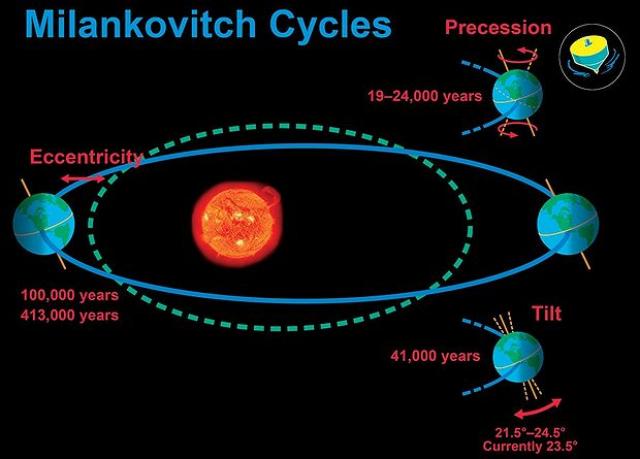
Here’s a graphical view of the cycles:

Credit Incredio – CC-BY-SA. Tap image for large original.
The first thing to realize about planetary orbits, as demonstrated by Johannes Kepler, is that they are not circular. As a first approximation, all orbits are elliptical. They orbit the central body on an oval path, so sometimes the orbiting body is closer, while sometimes it is farther away. In other words, for part of the year Earth is closer to the Sun than it is on the other half of the orbit. Presently, we are at our closest during the part of the orbit where it is winter in the northern hemisphere. It seems quite nice that things would be set up that way, doesn’t it? The part of our planet that has more land and more people is closer to its heat source during the coldest part of the year.
How does this affect our climate, and what is orbital eccentricity anyway? As there is more land in the north and more water in the south, the current regime keeps us a little warmer. Incoming sunlight is reflected more by snow-covered land than by open water. It has a higher albedo. If the great northern continents had more snow cover, as they would in longer, colder winters, they would reflect more sunlight and cool even more. One ingredient for a possible ice age. One component in our current lack of glaciation.
Orbital eccentricity, the Milankovitch cycle in this post, is the name for how elliptical an orbit is. A nearly circular orbit is less eccentric, and a more elliptical one is more eccentric.
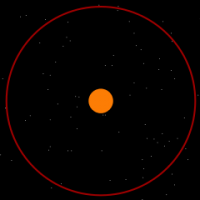
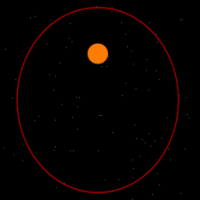
The astounding fact is that Earth’s orbit oscillates between more and less eccentric in a 100,000 year cycle. That variability is one of the astronomical factors that Milankovitch calculated in his quest to see if such things could contribute to the ice ages discovered by geologists. Currently the eccentricity is near its minimum — our orbit is nearly circular — with a difference of only about three percent between the smallest and greatest distance from the Sun in a year. This tends to keep us a little warmer. However, the eccentricity is increasing, which should lead to a cooling trend. When the orbit is more elliptical, with the Sun at one focus of the ellipse, the Earth spends more time farther from the Sun, out on the long end of the ellipse. This leads to a gradual cooling trend, contributing to the possibility of accumulating snow and ice. On average during this latest Ice Age, comprising the last few million years, the approximately 100,000 year cycles are roughly 80% cold and glacial, and 20% warm and interglacial.
The 100,000 year cycle in Earth’s orbital eccentricity is the dominant cycle contributing to cooling and warming. The other, shorter cycles make their contribution when they ‘sync’ up with the big one. We’ll talk about those cycles in future posts, beginning with axial obliquity.
rjb