Spider Feet


Edit: See below for more on the eyes of jumping spiders.

Geckos aren’t the only animals that use van der Waals force to stick to the ceiling. Scientists in Germany and Switzerland have been using electron microscopes to look at the feet of jumping spiders. There they’ve found the same hairs-covered-by-hairs combination that gecko feet have. Once again the hairlets are so small that they can fit into the force fields around molecules and stick fast. Calculations show that the total sticking power of their feet could theoretically hold 173 times their weight.

The jumping spiders – hunters, not web builders – have an added twist to their use of van der Waals force fields. They don’t simply make passive use of the force. The structure of the setules, the smaller hairlets on their feet, allows their van der Waals forces to combine into a very strong overall force on each foot. The spiders are producing their own adhesion, not just making use of the existing forces in the ceiling.

Like geckos, jumping spiders can stick to the ceiling even if it’s wet or oily, no matter how smooth it is. That’s because the setules and the molecules of the ceiling meet in spaces so small that concepts of roughness and wetness simply don’t compute.

This research opens up interesting possibilities for adhesives. Dry, all-purpose, all-weather, reusable duct tape comes to mind.

Jumping spiders sound like the nightmares of the small world. Unlike some other species of spiders, which can have their eight eyes arranged all around their heads, hunting spiders tend to have theirs clustered on the front. All the better to focus on their prey, I imagine. Some of them also bungee jump. They go after flying prey, including birds for some larger spiders, by jumping into the open air. If they miss they haul back up the strand of web to where it’s attached at their launch site and wait for the next meal on wings.

All this and sticky feet, too. Their ability to cling to any surface, focus acutely on moving objects and jump great distances add up to an extremely efficient hunter. It makes you wonder if any of them hunts geckos. Hunter and prey running across the same molecular force field.

rjb

Edit: More information on the kind of vision jumping spiders have in their eight eyes.
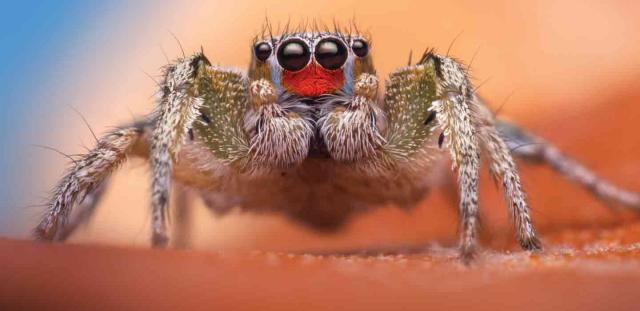
Credit Science News

The principal eyes — the big forward-facing ones that just beg us to anthropomorphize — have incredibly high resolution for creatures that are usually between 2 and 20 millimeters long. Their eyesight is sharper than any other spider’s and is the secret behind their ability to stalk and pounce on prey with impressive precision. Their sight is comparable to that of much larger animals like pigeons, cats and elephants. In fact, human visual acuity is only about five to 10 times better than a jumping spider’s.

Follow this link to a Science News article about the fascinating visual world of jumping spiders.

rjb
Posted in Uncategorized | Tagged , | Leave a comment

Gecko Feet

Since the characters in Green Comet have “gecko feet,” I thought it would be good to republish an original article from my erstwhile newspaper column, “Tech Nickels.” This was originally published when biomimetic scientists were first uncovering the marvels of these little creatures’ feet.

Geckos are small, carnivorous lizards, usually found in the tropics. They work the night shift, eating insects. They’re harmless to humans and are generally welcome in and around homes. An adult gecko weighs about 50 grams, or about as much as a small box of tea.

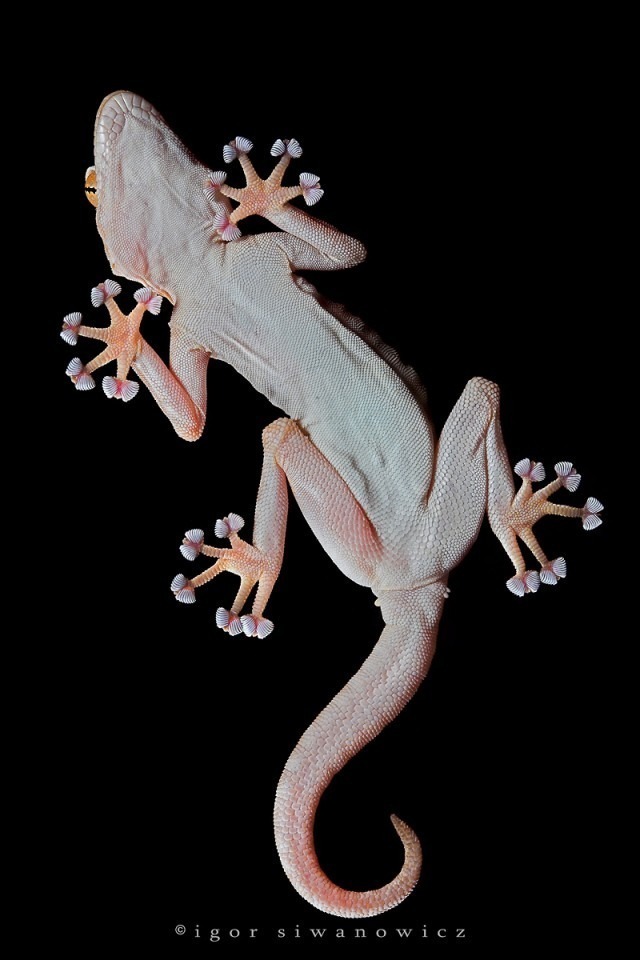
A gecko can run across a dusty road and straight up a wall. Its feet are so sticky that it could hang from smooth glass by one toe. People have been amazed by the phenomenon for millennia and have been trying to figure it out for as long. We know now that the answer is in the gecko’s hairy feet.

Each of its four feet has about five hundred thousand hairs which can be seen with an optical microscope. But the real secret is smaller than that; smaller than the wavelength of light even. An electron microscope shows that the end of each hair has hundreds of smaller hairs, each tipped with a flat pad. These structures are so small that they can take advantage of the force binding the wall’s molecules together.

It doesn’t use suction or hooks or sticky goo. Unlike suction, as used by salamanders, gecko feet can stick without a pressure differential. Without hooks or grapples, as used by cockroaches, gecko feet can stick to surfaces too smooth to be hooked or grabbed. Without glue, as used by snails, gecko feet stick wet or dry. The little pads on the little hairs covering the contact surfaces of a gecko’s fantastic feet are so small that they can squeeze into the little bubbles of van der Waal’s force around the atoms and molecules in whatever surface they’re on.

Wouldn’t that be great for hanging a picture? I don’t mean using a gecko to stick it to a wall. That would be inconsiderate of the gecko. I mean manufacturing a kind of tape that could be used repeatedly. And since the combined adhesion of all of its feet would hold up a gecko the size of a large hockey player, such a tape would have many uses. It would certainly hold on a car fender, for instance.

Naturally this hasn’t gone unnoticed. A recent branch of science called “biomimetics” devotes itself to learning how it’s been done in nature and seeing if it’s possible to mimic in the laboratory. In the case of gecko feet, they’ve done quite well. So far their gecko tape can support a little more than the real thing.

When something new appears like this, it’s tempting to try to guess where it will show up in the day-to-day world. In medicine? On rock climbers? It will probably inspire a new razor. These things usually do.

See the companion post on spider feet.

rjb

Posted in Uncategorized | Tagged | 5 Comments

Extensions to Green Comet

Many of the people who read Green Comet ask if there will be more. While I wrote the novel I wasn’t thinking of that and I wasn’t planning anything beyond this book. All I wanted was to put together a serviceable story, release it into the wild and see what happened. It’s still early times in the experiment, but it has produced a result. It seems that some of the readers like it enough to ask for more. So, what do I do?

I’ve decided to try to write more. It won’t be a sequel, though. I’m not going to write another whole novel continuing the story I began with Green Comet. Instead, I’m going to try what I think of as an extension. A short piece of one or a few chapters that illuminates another small bit of the universe of Green Comet. That shouldn’t take quite so long.

It’s still going to take a while, though. Months, maybe more. So in the meantime, I repeat my invitation to all of you to create your own extensions. Surely someone can get there before I do.-)

rjb

Posted in Uncategorized | Tagged | Leave a comment