Size – Stars

Image credit - Dave Jarvis - CC-BY-SA

Image credit – Dave Jarvis – CC-BY-SA

Click images for larger versions.

How big is the biggest* star? I’m sure most people, once they learn that stars come in different sizes, will ask themselves that question. The answer, of course, is provisional. According to calculations, the biggest a star can be before the force of its radiation overcomes the strength of its gravity is 150 solar masses. (Stars are measured as multiples of our Sun.) At that size they radiate so fiercely that they blow away mass faster than they can accumulate it. However, in theory the conditions were right shortly after the Big Bang for the formation of stars of 300 solar masses. So, let’s say that the biggest star should be 150 – 300 solar masses.

Image credit - Urhixidor - Public Domain

Image credit – Urhixidor – Public Domain

That brings us naturally to the question of how small the smallest star can be. Again, we have to set the criteria. Should a star be something that glows by its own light, or should we be more strict? I prefer the requirement that a star must be heated by hydrogen fusion, as a distinct cut-off. Otherwise, really big planets heated to glowing by intense gravitational compression might be called stars, and the line would be blurred. At 93 times the mass of Jupiter, AB Doradus C is the smallest known star by that criterion. The theoretical lower limit is 75 Jupiters. Below that is the blurry area occupied by objects called brown dwarfs. Another blurry line at about 13 Jupiter masses separates brown dwarfs from gas giants like Jupiter. It would take over a thousand Jupiters to make our Sun.

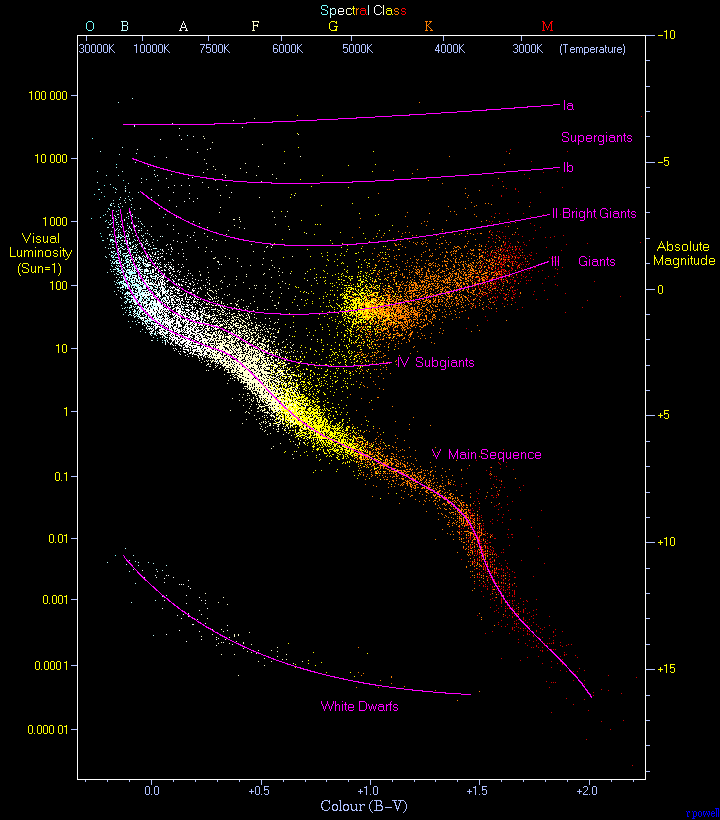
For a broad picture of star sizes, here’s the Hertzsprung-Russel Diagram.

Image credit - Atlas of the Universe

Image credit – Atlas of the Universe

* for this article, bigness is defined by mass, not physical size.

rjb

Posted in Uncategorized | Tagged , | 1 Comment

Noctilucent

Photo credit - Bill Valentine

Photo credit – Bill Valentine

Cloud of the Day – Noctilucent

Photo credit - Jan Koeman

Photo credit – Jan Koeman

You thought nacreous clouds were high? Well, at as much as 80,000 feet they are, but compared to noctilucent clouds, nacreous are practically scraping the ground. Like nacreous, noctilucent clouds are best seen when the Sun is just below the horizon for the observer. They are so high that they are still illuminated by the Sun when it’s getting dark on the ground. That’s why they’re called noctilucent, or “night shining.” These clouds, also called polar mesospheric clouds, have been observed at well over eighty kilometers above the ground.

Photo credit - Ralph Croning

Photo credit – Ralph Croning

Noctilucent clouds are made of ice crystals. That requires water vapor and nucleation particles for the vapor to condense on. The water vapor is pumped up there by the strong convective energy found in the summer months. Even at that extreme height, some of the water can make it. Getting the particles that high is much more difficult. The best candidates are from the most powerful volcanoes, and dust actually sifting down from space.

The color of noctilucent clouds ranges from white to electric blue, glowing as if with their own light. There is no precipitation from noctilucent clouds.

rjb

Posted in Uncategorized | Tagged , , | 12 Comments

Size – Solar System

Photo credit - NOAO

Photo credit – NOAO

The American National Optical Astronomy Observatory has provided a model that can be used to visualize the size of the Solar System. Various objects are used to represent the Sun and planets, such as a ball for the Sun and a peppercorn for Earth. Units will be in inches and yards, since the source is American, with metric equivalents in brackets. For example, the Sun is represented by an eight inch(20 cm) ball, and the peppercorn representing Earth is .08 inches(.20 cm) in diameter.

Three of the planets, Mercury (shown above in transit of the Sun), Mars and Pluto, are pinheads. Mercury’s pinhead is .03 inches(.08 cm) across. Mars is .04 inches(.10 cm) and Pluto is .01 inches(.03 cm.) We’re including Pluto as a planet even though it has recently been reclassified as a Kuiper Belt Object. Two planets, Venus and Earth, are peppercorns at .08 inches(.20 cm) across. Jupiter is a chestnut at .90 inches(2.40 cm.) Saturn is a hazelnut of .75 inches(2.00 cm) diameter. Both Uranus and Neptune are peanuts of .30 inches(.80 cm.)

Now we have one ball, one chestnut, one hazelnut, two peanuts, two peppercorns and three pinheads. Next we need a place to lay them out to show how far apart they are. We can’t do it indoors because there simply wouldn’t be enough room, so we have to go out. The back yard is too small, too. None of the playing fields is big enough, either. The airport just might do it. We’ll put the Sun, the twenty centimeter ball, down at one end of the airport, in the grass near the fence because the paved runway isn’t long enough by itself. Then we’ll pace off the distances to the planets, assuming one yard (a little less than one meter) per pace.

The first planet out from the Sun is Mercury, at ten paces. We’ll put the first pinhead there, and we’d better mark it with a flag so it doesn’t get lost in all that space. Take another nine paces and put down a peppercorn for Venus. Another seven paces and we can mark Earth with the second peppercorn. Then there’s a jump of fourteen paces to get to Mars and its pinhead. We’re forty paces out now and we’ve placed the four inner planets already.

Now we start to cover ground. Jupiter, the largest planet in the Solar System, bigger than the rest combined and almost one tenth of one percent as massive as the Sun, is 95 paces beyond Mars. Put down the chestnut. Saturn the hazelnut is next at 112 more paces. Uranus is another 249 paces and Neptune 281 paces beyond that. Down go the peanuts. All we have left is one pinhead for Pluto, which is another 242 paces. At a total of 1,019 paces, we might still be inside the fence at the far end of the airport. If the Sun wasn’t shining at the other end, we’d never see it.

To put it in perspective, the Moon, which is the farthest any human has gone, is 2.4 inches(6 cm) away from Earth’s peppercorn. Mars, one of the closer planets, is over 200 times as far as that. This model shows how big and empty space really is.

Here’s a bonus photo from NOAO, showing, from top to bottom, the Moon, Venus, the star Spica and Jupiter, in conjunction above an observatory in Chile.

Photo credit - NOAO

Photo credit – NOAO

rjb

Posted in Uncategorized | Tagged , , , | 7 Comments