Types Of Intelligence

9-types-of-intelligence-infographic

In 1983 psychologist Howard Gardener wrote a book describing multiple types of intelligence.  Before then, ability in mathematics and language qualified for intelligence, but other abilities did not.

If you click on the image at the top of this post, you will see an infographic showing the 9 types of intelligence described in Howard Gardner’s book, Frames of Mind: The Theory of Multiple Intelligences.  If you click on the link at the bottom of this post, you will be taken to an article describing them in greater detail.

What other scientists thought were just soft-skills, such as interpersonal skills, Gardener realized were types of intelligence. It makes sense. Just as being a math whiz gives you the ability to understand the world, so does being “people smart” give you the same ability, just from a different perspective. Not knowing math you may not calculate the rate at which the universe is expanding, but you are likely to have the skills to find the right person who will.

Here are the nine types of intelligence, as seen by Gardner:

Naturalist (nature smart)
Musical (sound smart)
Logical-mathematical (number/reasoning smart)
Existential (life smart)
Interpersonal (people smart)
Bodily-kinesthetic (body smart)
Linguistic (word smart)
Intra-personal (self smart)
Spatial (picture smart)

Source: 9 Types Of Intelligence – Funders and Founders

Posted in Uncategorized | Tagged , , , | 4 Comments

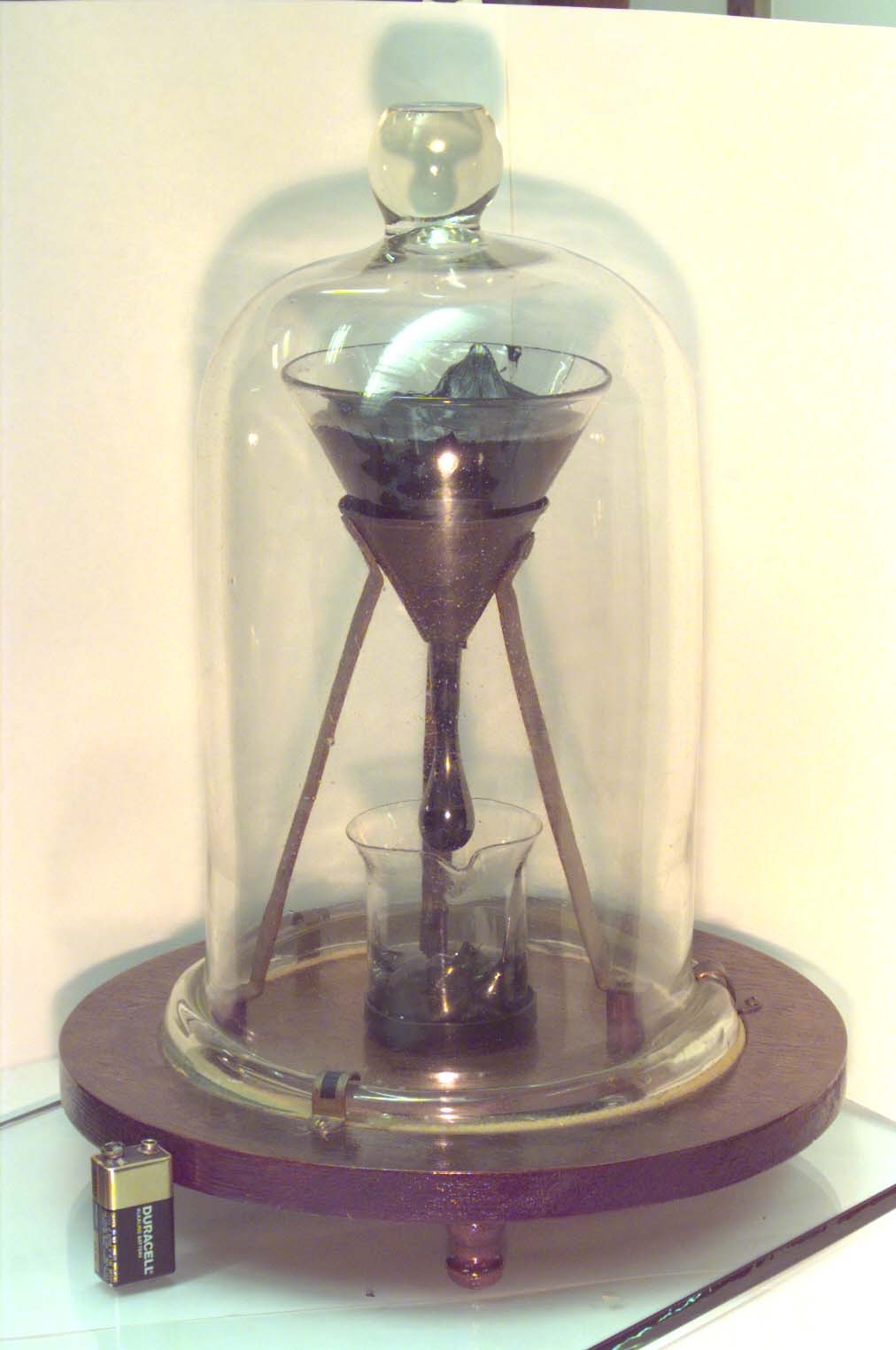
Pitch Drop Experiment

Professor John Mainstone, Queensland University, with the experiment

Professor John Mainstone, Queensland University, with the experiment

It has taken me a long time to get around to this post, but that’s all right. It’s not as if the story is going to go cold. Or any colder, anyway. It might be two years since the last significant development in the pitch drop experiment, but it will probably be twelve more before the next one.

Credit John Mainstone, University of Queensland - GNU Free Documentation License

Credit John Mainstone, University of Queensland – GNU Free Documentation License

This pitch drop experiment (there are others) was begun in 1927 at the University of Queensland in Brisbane, by Professor Thomas Parnell. There is another pitch drop experiment running at Trinity College in Dublin, which was begun in 1944, but it hasn’t been continuously monitored. It has accumulated several drips unobserved, so its data are incomplete. It did catch its most recent drip on camera, though, with time-lapse photography. Yet another experiment has been unearthed in Wales. That one started in 1914, even before the Australian one, but it has yet to produce its first drip. One has to admire the dedication of researchers who stick with an experiment that will still be running long after they’re dead. It even has its own YouTube channel.

With no data from Wales and incomplete data from Ireland, the only useful data come from the Australian experiment. Using those data, they have calculated that their pitch, under their conditions, is 230 billion times as viscous as water.

Since Professor Parnell initially began the pitch drop experiment to demonstrate to his students that apparently solid substances can simply be highly viscous liquids, I’d say the experiment is a success. Unfortunately, given that it’s almost 90 years later, it’s probable that his students are dead

rjb.

Posted in Uncategorized | Tagged , , , | 1 Comment

Orgasm – Color

Credit Michael Maggs - CC-BY-SA

Credit Michael Maggs – CC-BY-SA

Synesthesia of the Day – Orgasm – Color

Since synesthesia (my first post on synesthesia) is a major element in the Green Comet series of novels, I thought it would be a good idea to write a series of posts about synesthesia. What better way to start than with orgasm – color synesthesia? Color because it is the best known and probably most common synesthetic effect, and orgasm because, well, orgasm.

Where to start was actually a problem, and not because there is a lack of choice. When I went looking for a definitive list of the types of synesthesia, I couldn’t find one. I found references with a few examples, and others with graphs and tables, but none with a straightforward, well organized list. Another problem was the lack of standardized naming. For instance, the first example of synesthesia that most people learn about is where the letters of the alphabet have their own distinctive colors. So, that would be letter – color synesthesia, right? Well, it turns out that numbers have their own colors, too. So now it’s grapheme – color. And combinations of letters or numbers have theirs. And words. And parts of words. And the sounds of parts of words. Once we begin finding them, we don’t seem to be able to stop. It reminds me of the fundamental particle problem, where every time theory predicted one, it was only a matter of time before experiment confirmed it. That was a burgeoning mess until the quark model simplified it by making all the particles just combinations of a few quarks. Synesthesia is at that point now. Every time we think of a new possible form of it, someone finds it. Synesthesia needs its quark model, to tame this mad proliferation. I won’t be presenting that theory. I’m not that smart. So for this series of blogs I’ll be picking from the large, and growing, list of types of synesthesia that I have been able to compile. Beginning with orgasm – color.

The descriptions of the colors experienced leading up to and during orgasm seem like a cliche. Like the scenes of bursting fireworks that the family-oriented movie will cut to at the crucial moment. It turns out that the euphemism probably has a basis in fact. “… colours of increasing intensity.” Walls bursting with, “ring-like structures … in bluish-violet tones.” So it seems that a lot of what we assumed were just metaphors for an indescribable experience are, in some cases at least, descriptions of real sensations.

More women than men experience synesthesia. The ratio persists for experiencing orgasm – color synesthesia.

rjb

Posted in Uncategorized | Tagged , , , , | Leave a comment