Will Pluto Be a Planet Again?

And will the Moon soon be one too? As mentioned in my post Size – Solar System, Pluto lost its planetary designation over ten years ago. In 2006, the International Astronomical Union demoted Pluto from planet status to that of Kuiper belt object. Pluto didn’t meet all of their criteria to be called a planet. While it orbits the Sun without being the moon of another object, and it has enough gravity to form itself into a spherical shape, without having so much that it ignites a fusion reaction like a star — two of their criteria — it hasn’t cleared its orbital zone of most other bodies — their third criterion. There are a lot of other trans-Neptunian bodies out there, especially in the region called the Kuiper Belt. Pluto was relegated to the status of just another Kuiper Belt object (KBO). I agreed with them. Even though their criteria are incomplete and somewhat arbitrary, I think Pluto should be grouped with the other KBOs, rather than with the major planets. Rather than having a nearly circular orbit on or near the plane of the ecliptic, it has a very elliptical orbit canted at 17.16 degrees to the orbits of the planets. I think it should be called a minor (dwarf) planet, like Eris, another trans-Neptunian object, or Ceres, the largest asteroid belt object.  Many people disagree with me, though.  When the International Astronomical Union demoted Pluto, a great howl went up in defence of the little planetoid.  Now there is a movement afoot to change the definition of planet so Pluto can regain its previous status.  If they are successful, then there could be more than a hundred more planets added to the Solar System.

The key change the team is hoping to get approved is that cosmic bodies in our Solar System no longer need to be orbiting the Sun to be considered planets — they say we should be looking at their intrinsic physical properties, not their interactions with stars.

They want each body to be assessed on its own attributes, and not its relationship with other bodies. So what it orbits or how it does so would not come into it. Based on this, the Moon could become a planet, as could many of the moons of other planets. Here is their definition:

A planet is a sub-stellar mass body that has never undergone nuclear fusion and that has sufficient self-gravitation to assume a spheroidal shape adequately described by a triaxial ellipsoid regardless of its orbital parameters.

Put simply, anything massive enough to be round, but not as massive as a star. Anything up to and including what were formerly called brown dwarf stars (About 15-75 times as massive as Jupiter. See my post Size – Stars.) This would include a large and growing number of objects in the Solar System, and in other extrasolar systems, as well as any qualifying bodies that are not associated with any star. Those so-called “rogue” planets.

What do you think? Is it worth all that just to get Pluto its planetary status back?

Source: NASA scientists have proposed a new definition of planets, and Pluto could soon be back – ScienceAlert

rjb

Posted in Uncategorized | Tagged , , , | Leave a comment

I ♥ Free Software – Valentine’s Day 2017


Source: I ♥ Free Software – Valentine’s Day 2017 – FSFE

I Love Free Software Day has rolled around again. It’s easy to remember since it falls on Valentine’s Day every year.

Free Software drives a huge number of devices in our everyday life. It ensures our freedom, our security, civil rights, and privacy. It enables everyone to participate in a fair society. But as with people, everybody has different reasons to love Free Software. Let’s show this variety to the world!

Since I use Free Software to run this website, as well as to write my books, I am more than happy to give a shout out to all the world’s free software developers. Thank you, and please continue.

It doesn’t matter who and where you are and what you do – everyone can participate at the “I love Free Software” day in many different ways:

Thank contributors to the free and open source ecosystem personally.

Do it on social media, using this hashtag: #ilovefs

Do it on your blog. Link this blog, or link the original.

Happy I love Free Software day everyone!

And happy Valentine’s Day, too.

rjb

Posted in Uncategorized | Tagged , , | Leave a comment

Milankovitch Cycles – Other


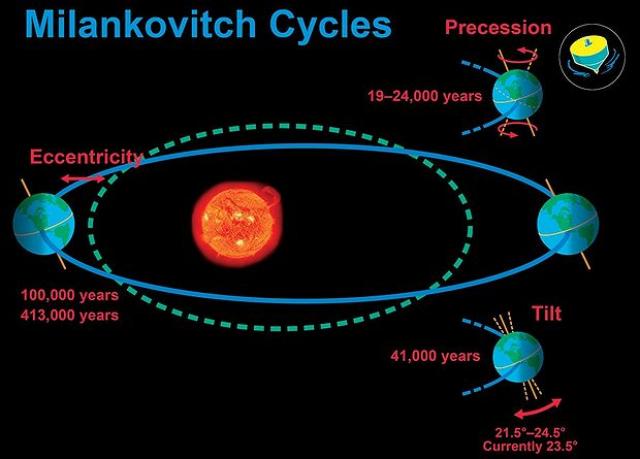
See the previous posts on Milankovitch cycles: orbital eccentricity, axial obliquity and axial precession.

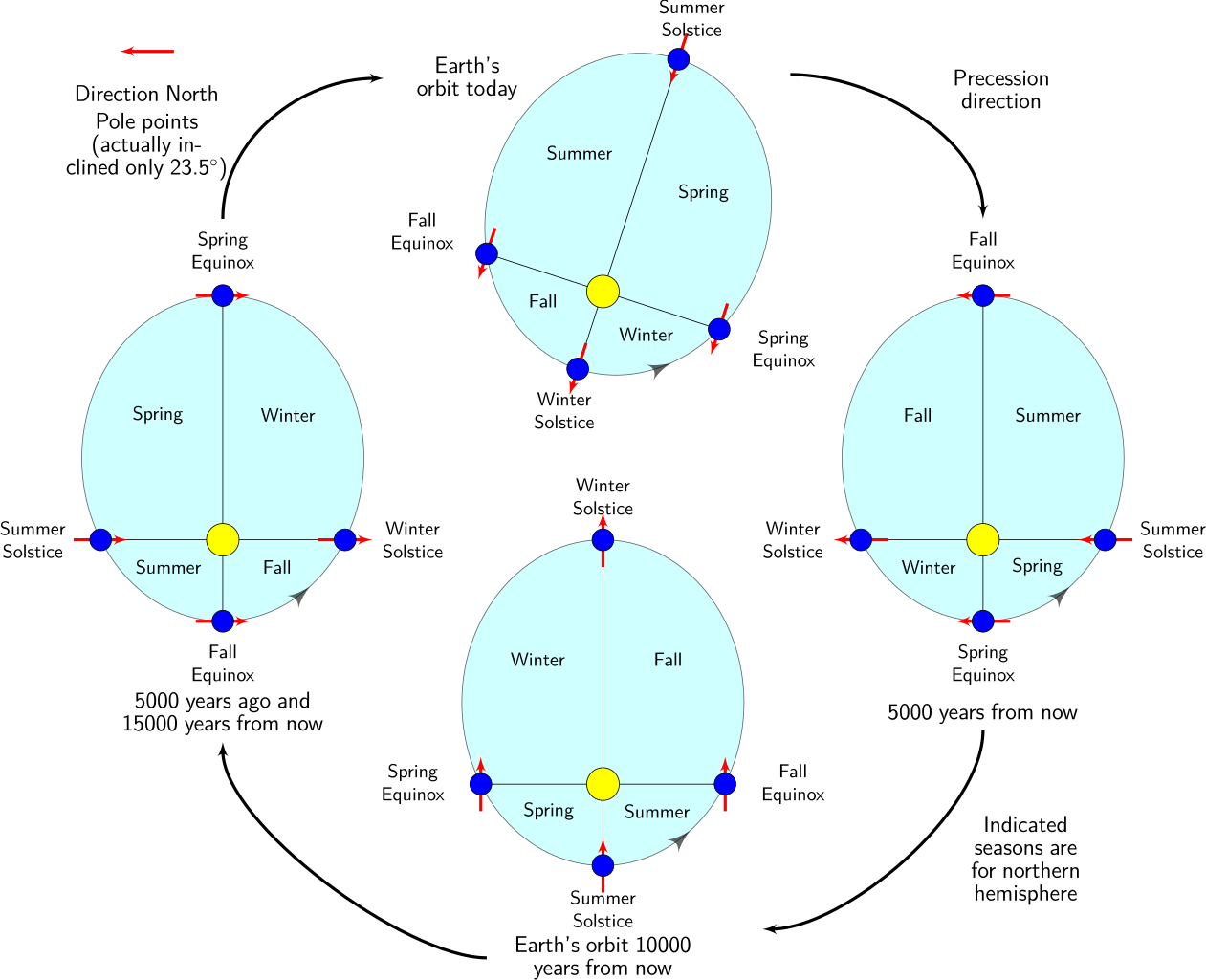
There are two more cycles to consider in this increasingly complex story of the astronomical cycles affecting Earth’s long-term climate. The first is another form of precession. Similarly to the precession of Earth’s axis, which marks out a circle on the star field every 26,000 years, the ellipse of Earth’s orbit around the Sun also precesses. That is, the orbit itself revolves, with the apsides of the orbital ellipse — the points of nearest and farthest approach — revolving about every 112,000 years relative to the fixed stars. Combining orbital precession with axial precession means that on average it takes about 23,000 years for the equinoxes to go through one cycle and return to the same calendar date. This affects climate by changing where on the orbit the seasons occur.

Credit Krishnavedala – CC-BY-SA – Tap for larger.

The other cycle, and the last one we will look at, is orbital inclination. It turns out that the plane of Earth’s orbit around the Sun is tilted relative to the Sun’s equator, and also relative to the Solar System’s so-called invariable plane. The invariable plane can be thought of as the rotational plane of the whole Solar System, mostly defined by the big gas giants: Jupiter, Saturn, Uranus and Neptune. The plane of Earth’s orbit is tilted relative to that by 1.57 degrees. The tilt of our orbit rocks up and down on about a 100,000 year cycle. That is, our tilt relative to the Sun and the rest of the Solar System is not constant, but changes over time. This affects climate by changing the apparent tilt of our axis relative to the Sun, affecting seasonal variation. Depending on the tilt of our orbit relative to the Sun, the same axial orientation relative to the fixed stars results in varying tilt relative to the Sun.

Credit Lasunncty – CC-BY-SA – Tap for larger.

The Milankovitch cycles, and the others that weren’t known in his time, are well understood, and their effect on Earth’s climate is well accepted by climatologists. That doesn’t mean that we’ve got it all sewed up. There is the matter of the well established 100,000 year cycle in glaciation matching the 100,000 year orbital cycles, while those cycles have the weakest effect on climate. Then there’s an unexplained change from a 41,000 year ice age cycle that lasted for two million years, to the 100,000 year one that’s been in force for the last million. And there are others. There is still plenty of work for climatologists.

To recap: We have looked at the astronomical events that Milutin Milankovitch considered to be implicated in Earth’s Ice Ages. We began with a brief look at his life, then followed up with the three main cycles examined by him: orbital eccentricity, axial obliquity, and axial precession. And now we have tacked on orbital precession and orbital tilt. All of these things, and possibly others not yet discovered, interact in a complicated dance that results in the recurring cycles of glaciation. Milankovitch pointed out that the most important effect is the amount and intensity of insolation at the mid-latitudes, particularly in the northern hemishpere’s summer. Warmer summers tend to prevent the buildup of snow and ice on the big continental land masses.

A note of caution: the Milankovitch cycles are seized upon as an example of natural forces that affect climate change, often with the hope that they will negate the reality of our current climate change, or at least absolve us of our responsibility for it. This is a false hope. If it were true, then the cycles should be trending toward warmer, but they’re not. Orbital eccentricity is increasing, which should promote a cooling trend. Axial tilt is decreasing, also normally leading to cooling. If anything, Earth should be cooling. The fact that it’s warming should make it clear that something else is counteracting the astronomical effects. The most economical hypothesis would seem to be that we are releasing the solar energy captured and buried by plants hundreds of millions of years ago, by burning the resulting fossil fuels. Compounding this is the insulating effect of the carbon dioxide released in the process, leading to a warming of the atmosphere. Don’t blame Milutin.

Now that I’ve put you through all this, here’s a link to a nine minute video that brings it all together.

rjb

Posted in Uncategorized | Tagged , , , , , , , | Leave a comment