Aurora

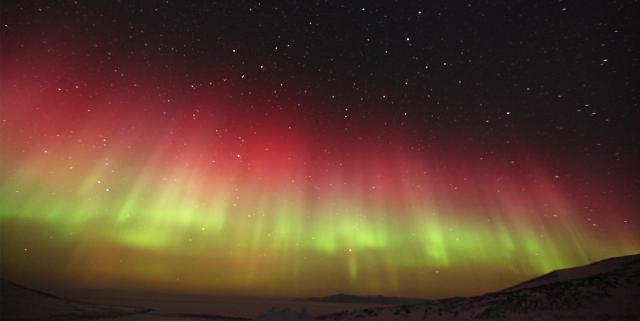
Photo credit - Deven Stross CC-BY-NC-ND

Photo credit – Deven Stross CC-BY-NC-ND

Cloud of the Day – Aurora

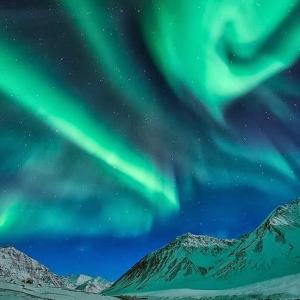
Aurora is not clouds. Clouds can’t form in the tenuous wisps of atmosphere found at the heights, approximately 90 – 1,000 kilometers, where aurora occurs. Therefore, it is wrong for me to call aurora the cloud of the day. Naughty me. It’s a meteorological phenomenon, and it’s beautiful. I’ll call it the cloud of the day if I want.

Photo credit - Alan C Tough

Photo credit – Alan C Tough

Photo credit - Andia Frh

Photo credit – Andia Frh

The Northern Lights, aurora borealis, were named in 1621 by Pierre Gassendi, a French scientist, priest and philosopher. Boreas was the Greek name for the north wind, and Aurora was the Roman goddess of the dawn. The Northern Lights are mirrored around the south pole by aurora australis, the Southern Lights.

Photo credit - 14jbella Click image for huge poster

Photo credit – 14jbella
Click image for huge poster

Photo credit - John Freddy

Photo credit – John Freddy

The aurorae work on the same principle as a neon lamp. Energized atoms release the excess energy as photons of light. In a neon lamp, the atoms are energized by electricity. In aurorae, nitrogen and oxygen atoms are energized by the solar particles that are trapped and funneled into the upper atmosphere by Earth’s magnetic field. When intense enough to be more than a whitish glow, the most common colors are green from oxygen and red from nitrogen. Other colors result from mixing of the main colors, or from variations in the excitation-release mechanism. For example, the rare blue that sometimes comes from nitrogen.

Photo credit - Aaron Kaase - Public domain

Photo credit – Aaron Kaase – Public domain

Although it might be interesting, there is no precipitation from aurora.

rjb

Posted in Uncategorized | Tagged , , , , | 6 Comments

Size – Stars

Image credit - Dave Jarvis - CC-BY-SA

Image credit – Dave Jarvis – CC-BY-SA

Click images for larger versions.

How big is the biggest* star? I’m sure most people, once they learn that stars come in different sizes, will ask themselves that question. The answer, of course, is provisional. According to calculations, the biggest a star can be before the force of its radiation overcomes the strength of its gravity is 150 solar masses. (Stars are measured as multiples of our Sun.) At that size they radiate so fiercely that they blow away mass faster than they can accumulate it. However, in theory the conditions were right shortly after the Big Bang for the formation of stars of 300 solar masses. So, let’s say that the biggest star should be 150 – 300 solar masses.

Image credit - Urhixidor - Public Domain

Image credit – Urhixidor – Public Domain

That brings us naturally to the question of how small the smallest star can be. Again, we have to set the criteria. Should a star be something that glows by its own light, or should we be more strict? I prefer the requirement that a star must be heated by hydrogen fusion, as a distinct cut-off. Otherwise, really big planets heated to glowing by intense gravitational compression might be called stars, and the line would be blurred. At 93 times the mass of Jupiter, AB Doradus C is the smallest known star by that criterion. The theoretical lower limit is 75 Jupiters. Below that is the blurry area occupied by objects called brown dwarfs. Another blurry line at about 13 Jupiter masses separates brown dwarfs from gas giants like Jupiter. It would take over a thousand Jupiters to make our Sun.

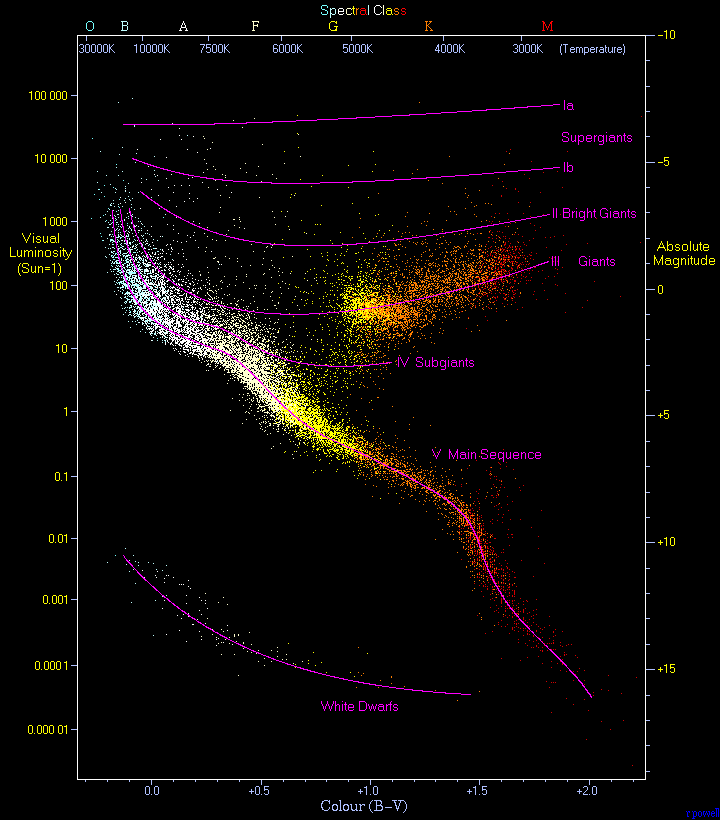
For a broad picture of star sizes, here’s the Hertzsprung-Russel Diagram.

Image credit - Atlas of the Universe

Image credit – Atlas of the Universe

* for this article, bigness is defined by mass, not physical size.

rjb

Posted in Uncategorized | Tagged , | 1 Comment

Noctilucent

Photo credit - Bill Valentine

Photo credit – Bill Valentine

Cloud of the Day – Noctilucent

Photo credit - Jan Koeman

Photo credit – Jan Koeman

You thought nacreous clouds were high? Well, at as much as 80,000 feet they are, but compared to noctilucent clouds, nacreous are practically scraping the ground. Like nacreous, noctilucent clouds are best seen when the Sun is just below the horizon for the observer. They are so high that they are still illuminated by the Sun when it’s getting dark on the ground. That’s why they’re called noctilucent, or “night shining.” These clouds, also called polar mesospheric clouds, have been observed at well over eighty kilometers above the ground.

Photo credit - Ralph Croning

Photo credit – Ralph Croning

Noctilucent clouds are made of ice crystals. That requires water vapor and nucleation particles for the vapor to condense on. The water vapor is pumped up there by the strong convective energy found in the summer months. Even at that extreme height, some of the water can make it. Getting the particles that high is much more difficult. The best candidates are from the most powerful volcanoes, and dust actually sifting down from space.

The color of noctilucent clouds ranges from white to electric blue, glowing as if with their own light. There is no precipitation from noctilucent clouds.

rjb

Posted in Uncategorized | Tagged , , | 12 Comments