Canadian Recording Industry: Works Entering the Public Domain Are Not in the Public Interest – Michael Geist

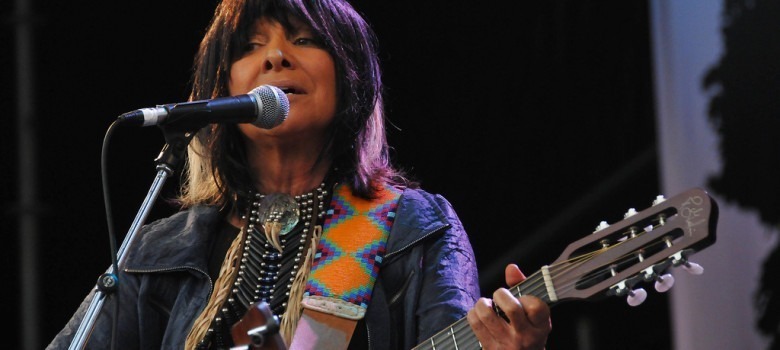
Buffy-Sainte-Marie-DSC_2407 by sidrguelph (CC BY-SA 2.0)

Who put the spin in spin doctor?  Not Buffy, that’s for sure.  Michael Geist is right on the mark, as usual.

rjb

On World Book and Copyright Day, it is worth noting how Graham Henderson, the President of Music Canada (formerly the Canadian Recording Industry Association) characterized the government’s decision to extend the term of copyright in sound recordings and performances:

“With each passing day, Canadian treasures like Universal Soldier by Buffy Sainte-Marie are lost to the public domain. This is not in the public interest.  It does not benefit the creator or their investors and it will have an adverse impact on the Canadian economy.”

This statement raises several issues. First, it should be noted that the song Universal Soldier by Buffy Sainte-Marie is not in the public domain nor will it be entering the public domain for decades. As the songwriter, Buffy Sainte-Marie still holds copyright in the song and will do so for her entire lifetime plus an additional 50 years.

Source: Canadian Recording Industry: Works Entering the Public Domain Are Not in the Public Interest – Michael Geist

Posted in Uncategorized | Tagged , | Leave a comment

Pillar

Credit - Brocken Inaglory - CC-BY-SA - Click for larger

Credit – Brocken Inaglory – CC-BY-SA – Click for larger

Cloud of the Day – Pillar

The pillar is an optical phenomenon where a light source, the Sun or the Moon or a streetlight, eg, is accompanied by a vertical column of light. Depending on the position of the light relative to the viewer, the pillar can be above or below the source, or both. Pillars are related to halos, being caused by light interacting with ice crystals, but can appear alone.

Credit S Moeller - Public Domain - Click for larger

Credit S Moeller – Public Domain – Click for larger

Credit Ikonet.com

Credit Ikonet.com

While halos are produced by the refraction of light through ice crystals, pillars form when the light reflects off of them. Because the ice crystals are all in different orientations as they sift through the air, the light source is reflected to you from different altitudes, elongating the reflection. Usually the type of ice crystal involved is the flat, hexagonal plate.

Credit - Hannes Grobe - CC-BY-SA - Click for larger

Credit – Hannes Grobe – CC-BY-SA – Click for larger

The pillar is not associated with any type of weather, only with the presence of ice crystals between the viewer and the light source.

rjb

Posted in Uncategorized | Tagged , , | 2 Comments

Creative Commons Logos at MOMA

Museum of Modern Art - CC0

Museum of Modern Art – CC0

Creative Commons logos are on display at the Museum of Modern Art in New York city. They are in a show of marks that have become ubiquitous in out modern culture. We all recognize these symbols, some more easily than others. The recycling symbol on many of the products we buy. The “at” symbol in email addresses. The “on-off” symbol next to the power button on our computers and other devices. And now the (cc) symbol being attached to much of our cultural media. MOMA has put on an exhibit of these marks, and announced that the Creative Commons logos are to be part of their permanent collection.

Creative Commons has posted an article on Medium.com, complete with pictures and a video, with nice detail about the organization, and about the creation and evolution of the logos.
creative-commons-logo-2
Quote from article:

“The Creative Commons logos are special and powerful symbols that speak to the origin and roots of the organization that created them. Creative Commons was founded in 2001 by Larry Lessig, Hal Abelson, and Eric Eldred to address a problem created by antiquated copyright laws in the U.S. and around the world. In an era where it was becoming easier to share works via the Internet, copyright law seemed to be moving in the other direction by increasing term limits and restrictions on reuse. Amidst this tension, how could artists, researchers, and other creators share their works widely and freely online without infringing on each other’s copyright? At the time, there was no way for a creator to grant blanket permissions for reuse, other than to hire their own lawyer to write custom copyright terms.”

Larry Lessig on the double-c:

“the multiple meanings of (c) doubled was important. If you create a question, you create a reason for people to try to listen.”

Go have a look, and see why I chose CC-BY-SA for Green Comet.

rjb

Posted in Uncategorized | Tagged , , , | Leave a comment