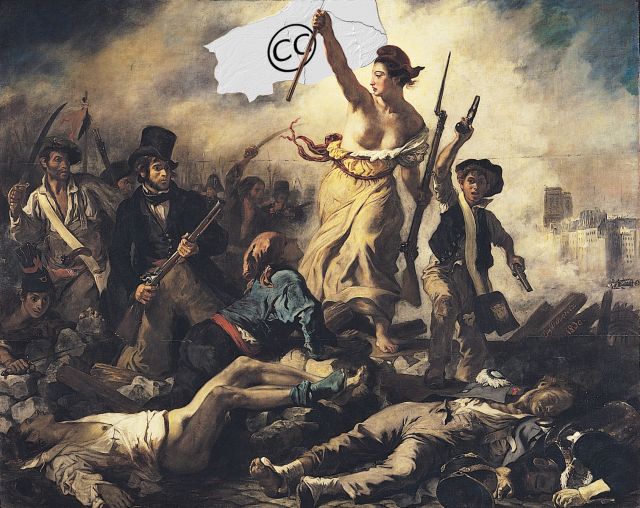
Farmers Demand Right to Fix Their Own Dang Tractors

Last Fall I published an article about iFixit, the activist group trying to make it safe, even possible for people to fix their own stuff. That article referred to a Wired article about the John Deere company trying to make it illegal for farmers to fix their own tractors. Now Modern Farmer has an article about how farmers feel about that.

– This might be hard to believe for non-farmers, but owners of tractors aren’t actually allowed to fix them, thanks to a set of laws designed to protect software intellectual property.

– John Deere, the world’s largest tractor maker, said that the folks who buy tractors don’t own them, not in the way the general public believes “ownership” works. Instead, John Deere said that those who buy tractors are actually purchasing an “implied license for the life of the vehicle to operate the vehicle.”

– Farmers are fed up with being forced to endure long, inefficient repair processes.

Source: Farmers Demand Right to Fix Their Own Dang Tractors – Modern Farmer

I’m tired of people using copyright this way. It’s bad enough that copyright has been extended so far that the original creator’s grandchildren will be dead before it expires. Now it’s being used to curtail competition in business. Could someone please throw a pitcher of ice water on our politicians? We need to break their thrall.

rjb

Posted in Uncategorized | Tagged , , , , | 2 Comments

Really Early Onset Alzheimer Syndrome

Public domain

Public domain

In a previous post, I referred to some research that seemed to indicate that there is a link between having a cynical and distrustful personality and later getting Alzheimer disease. As I explained then, this does not mean that being cynical causes the disease. All it is is a correlation. If anything, it might mean that the same underlying cause leads to both the cynicism and the dementia.

Now there is some more research that seems to indicate that at least one form of hereditary Alzheimer syndrome is beginning to affect the brains of its carriers much earlier in life. There is evidence of brain shrinkage as early as age three in some children with the APOEe4 gene mutation. This mutation is known to make its carrier fifteen times as likely to get dementia as non-carriers. It’s alarming that about fourteen percent of people carry this mutation, and it seems to be implicated in 20-25 percent of Alzheimer cases. Researchers stress, though, that genetics increase the risk, but do not guarantee the result. alzheimer-boy Interestingly, the APOEe4 gene mutation is also known to make people more susceptible to disease in general. Might it be that we’ll be able to prevent at least some Alzheimer cases by treating some childhood infection? If so, then might it be possible that we’d also see a reduction in cynical, distrustful people?

Mind you, given the implications of potentially altering people’s personalities, and possibly their politics, what are the odds that there will be a huge campaign against the treatment? Or is that too cynical?

rjb

Posted in Uncategorized | Tagged , , , | 2 Comments

In defence of Creative Commons – TechnoLlama

As you know, my novels are published with a Creative Commons license. I use Creative Commons Attribution Share-Alike (CC-BY-SA), but there are other variations, depending on how you want to share your work.  TechnoLlama, a blog I follow, has a piece on the resurgence of antipathy toward Creative Commons.  (TechnoLlama by Andres Guadamuz is licensed under a Creative Commons Attribution-NonCommercial-ShareAlike 4.0 International License.)  That license is the same as the one I use, with the addition of the NonCommercial part.  That means that Andres doesn’t want people re-using his work for commercial purposes, while I don’t mind if they do.

From TechnoLlama:

It is hard to imagine nowadays, but for a few years during the last decade Creative Commons was relentlessly attacked by some content owners, copyright maximalists and collective societies.

However, I have noticed a resurgence in criticism of Creative Commons.

Creative Commons has been extremely successful since its creation, and we must welcome debate and input about things that can be improved. At some point CC was seen as anti-establishment, a direct attack on copyright from clueless academics and pirates. After the open access movement gained traction, an interesting transition occurred, CC became a part of the establishment.

I’m glad that Creative Commons came along when it did. It took the copyright that is automatically applied to creative works and gave it greater scope and flexibility. Now, thanks to CC, I can share my work under my terms, while still retaining the power and authority of copyright. Before CC the only option was to declare the work Public Domain, relinquishing copyright.

Follow the link for the original article.

Source: In defence of Creative Commons – TechnoLlama

Posted in Uncategorized | Tagged , , , | Leave a comment