Wikipedia – The Free Online Encyclopedia

I have cited Wikipedia in many of my posts, and I’ve done it with no shame. Not everyone has shared my enthusiasm, though. Many people have used Wikipedia as an example of what is wrong with getting your information from the internet. They have disparaged its reliability, saying that anyone can contribute to it, so it can’t be a trusted authority. School teachers and college professors have even been known to ban and/or penalize its use, threatening to lower grades of offenders.

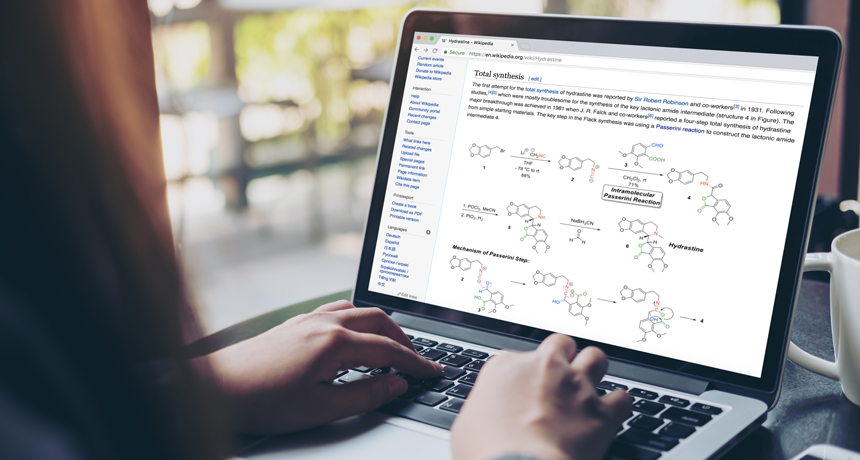
Teachers in middle school, high school and college drill it in to their students: Wikipedia is not a citable source. Anyone can edit Wikipedia, and articles can change from day to day — sometimes by as little as a comma, other times being completely rewritten overnight. “[Wikipedia] has a reputation for being untrustworthy,” says Thomas Shafee, a biochemist at La Trobe University in Melbourne, Australia.

I remember trying to tell some of those people that they were being too negative about Wikipedia. That its accuracy rivaled that of traditional encyclopedias. Typically, I was rebuffed, sometimes angrily. Not even comparisons to the democratizing effect of the printing press could bring them around. I gave up trying to convince them, but I never gave up using Wikipedia. Now it looks as if those of us who support it will be vindicated.

With hundreds of thousands of scientific entries, Wikipedia offers a quick reference for the molecular formula of Zoloft, who the inventor of the 3-D printer is and the fact that the theory of plate tectonics is only about 100 years old. The website is a gold mine for science fans, science bloggers and scientists alike.

But even though scientists use Wikipedia, they don’t tend to admit it.

… the site’s unreliable reputation may be unwarranted. Wikipedia is not any less consistent than Encyclopedia Britannica, a 2005 Nature study showed (a conclusion that the encyclopedia itself vehemently objected to). Citing it as a source, however, is still a bridge too far.

Academic science may not respect Wikipedia, but Wikipedia certainly loves science. Of the roughly 5.5 million articles, half a million to a million of them touch on scientific topics. And constant additions from hundreds of thousands of editors mean that entries can be very up to date on the latest scientific literature.

The linked article describes studies that explore the influence science has on Wikipedia, and the influence Wikipedia has on science in return. There appear to be very good reasons why scientists and scholars and educators should try to get over their prejudice against the online encyclopedia.

It’s a good reason for scientists get in and edit entries within their expertise, Thompson notes. “This is a big resource for science and I think we need to recognize that,” Thompson says. “There’s value in making sure the science on Wikipedia is as good and complete as possible.” Good scientific entries might not just settle arguments. They might also help science advance. After all, scientists are watching, even if they won’t admit it.

via Wikipedia has become a science reference source even though scientists don’t cite it | Science News

Posted in Uncategorized | Tagged , , , , , | Leave a comment

Update – The Plainsrunner

Credit finetooth – CC-BY-SA


Update

I have finished proofing the first section of The Plainsrunner (working title for my current novel) and will be moving on to publishing it. I have to do conversions to the various formats — ePub, PDF and MOBI — and then I have to make them available on the downloads page. Should I bother with a cover? Should I add any front matter or back matter? Copyright notice? I’m not sure what I’m going to end up doing.

The story is coming along well. It is accepting the elements I need to have in there, and it’s coming back with some interesting developments. I like that part of making a story, even though it can sometimes be a bit of a grind. I look forward to having this more mechanical part of publishing it done so I can get back to finding out what’s happening.

This is going to be shorter than the books in the Green Comet trilogy, and the pace is a little faster, too. I’m enjoying the change, and I hope you do as well.

rjb

Posted in Uncategorized | Tagged , , , | Leave a comment

It’s Never Aliens

UFO-self-made-Meersburg-Stefan-Xp-cc-by-sa-640

Credit Stefan Xp – CC-BY-SA – Self-made UFO over Meersburg

It was a good year for aliens. Whether it was the fluctuations in the brightness of Tabby’s star, the oddly shaped interstellar visitor that passed through the Solar System, or a spate of sightings of UFOs, aliens received a lot of nominations. As always with the advocates of alien visitations, they want us to prove that it isn’t aliens. They say, “How do you know it isn’t? Can you prove it isn’t?” They always get that backwards, don’t they?

From the Scientific American article:

What do a strangely fading faraway star, an oddly shaped interstellar interloper in the solar system and a curious spate of UFO sightings by members of the U.S. military all have in common?

Far from being close-minded killjoys, most scientists in the “never aliens” camp desperately want to be convinced otherwise. Their default skeptical stance is a prophylactic against the wiles of wishful thinking …

Finding aliens, or coming up empty in our searches, has profound implications for our own ultimate cosmic fate.

UFO detections have remained marginal for decades; they’ve just gone from being blurry shapes on film cameras to blurry shapes on the digital infrared sensors of fighter jet gun cameras. This, in spite of the fact that the world’s total imaging capacity has expanded by several orders of magnitude in the past 20 years.

Hypothetical aliens with advanced technology could do that, of course. But then you have to ask why they would choose to remain marginally undetectable rather than just being undetectable.

Read the original article at Scientific American.

via It’s Never Aliens–until It Is – Scientific American

It was a good year for alien hunters, but not good enough. They still haven’t come up with solid proof that their beliefs are true. I guess that’s why they keep asking us to prove that they aren’t, even though that’s the wrong way ’round.

rjb

Posted in Uncategorized | Tagged , , , , , | Leave a comment