What Emotion is That?

UntitledPhoto Credit: .kleine. cc-by-nc-sa.

via The Only Emotions I Can Feel are Anger and Fear – The Seattle Star

You don’t have to be a psychopath or a sociopath to have trouble feeling or identifying your emotions. You could have a recently identified condition called alexithymia, literally, “no words for emotion.” A person with alexithymia isn’t necessarily incapable of naming emotions, but they likely have a very unsubtle sense of what emotion they are feeling. They might interpret the increased heart rate of excitement as fear, for instance. It’s easy to see that such confusion about whether or what one is feeling can lead to many problems with relationships.

Despite the name, the real problem for people with alexithymia isn’t so much that they have no words for their emotions, but that they lack the emotions themselves. Still, not everyone with the condition has the same experiences. Some have gaps and distortions in the typical emotional repertoire. Some realise they’re feeling an emotion, but don’t know which, while others confuse signs of certain emotions for something else – perhaps interpreting butterflies in the stomach as hunger pangs.

In one of his first studies in this field, [Geoff Bird, a professor of psychology at the University of Oxford] linked alexithymia, as measured with a 20-item checklist developed at the University of Toronto, with a lack of empathy. If you can’t feel your own emotions in the typical way, it makes sense that you can’t identify with those of others, either.

“… for a few of our really alexithymic people, while they can tell a smile and a frown apart, they have no idea what they are. That is really quite strange.”

For Rebecca Brewer, a former student of Bird’s and now a lecturer at Royal Holloway, University of London, this makes sense. “With alexithymia, people often know that they are experiencing an emotion but don’t know which emotion it is,” she explains.

Some studies indicate that the inability to detect what is going on within one’s own body has a strong correlation with the condition of alexithymia.

The ability to detect changes inside the body – everything from a racing heart to a diversion of blood flow, from a full bladder to a distension of the lungs – is known as interoception. It’s your perception of your own internal state.

In 2016, Bird and Brewer, along with Richard Cook at City University in London, published a research paper that characterised alexithymia as a “generalised deficit of interoception”.

Geoff Bird wants to look at the idea that there are two different types of alexithymia. People with one type don’t produce enough of the bodily signals necessary for the experience of an emotion, so would be unlikely to benefit from the Sussex group’s kind of training. People with the other type produce all kinds of bodily sensations but their brains don’t process these signals in the typical way.

Bird stresses that, although people with alexithymia struggle to understand emotion, that doesn’t mean they don’t care about other people. “For the most part, individuals with alexithymia can recognise that others are in a negative state, and this makes them distressed. The problem is that they can’t work out what the other person is feeling, and what they are feeling, and therefore how to make the other person feel better or how to reduce their own distress. I think that’s important because alexithymia is different from psychopathy in that respect.”

It would be a terrible thing if the only emotions you could feel were fear, anger and confusion. Getting the diagnosis of alexithymia and some techniques and exercises to deal with it could make a big difference in a person’s life, and the lives of those around them.

Read the whole article here.

rjb

Posted in Uncategorized | Tagged , , , | Leave a comment

Continental Drift

Tap for animated GIF

Public Domain

Alfred Wegener had a lot of evidence for continental drift, but he didn’t have an explanation for how they did it. He had the curious way South America and Africa looked as if they should fit together. This was noticed almost as soon as good maps were available, but it was largely dismissed as coincidence. After all, it would imply that the two land masses had moved apart, and everyone knew that couldn’t happen. The idea was ridiculous.

He also had a geological connection. The rocks of South America and Africa matched up where they would have been joined had they once been a single land mass. It is the same two billion year old rock on the two separate continents.

In a similar example, there is an old mountain range — over 400 million years old — that today has its remnants in the widely separated areas of Canada, Greenland, Ireland, Scotland, England and Scandinavia. When these areas are put together, the so-called Caledonian mountain belt re-emerges.

Old glacial deposits put down during the Permo-Carboniferous glaciation 300 million years ago are found in the present day Antarctica, Africa, Australia, India and South America. The most economical explanation for this is that these continents were gathered around the south pole at the time.

Finally there is the fossil evidence. Often the same type of fossil is found on continents that are separated today, while being found nowhere else. Either this is because the continents drifted apart after the fossils were laid down, or something more improbable happened, such as breeding pairs swimming together to another continent and establishing the species there.

Public Domain

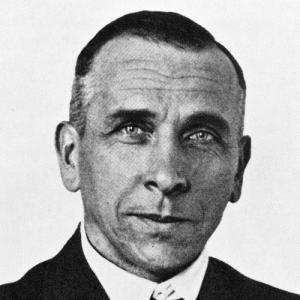
Alfred Wegener was born in 1880 and died in 1930, but his continental drift theory, first put forward in 1912, didn’t achieve wide acceptance until the 1950s. The expanding theory was developed in the four editions of his book, The Origins of Continents and Oceans, accumulating increasingly impressive evidence as it went. The theory had a few supporters, such as Milutin Milankovich, but since Wegener couldn’t come up with a convincing mechanism for how the continents moved, most scientists were sceptical. One even argued that the continents simply couldn’t “plow through” the oceanic crust. They also found fault with the imperfect fit of the jigsaw coastlines, not realizing that he was matching them at their continental shelves, where it is a much better fit.

Paleomagnetism, a new science in the 1950s, produced much evidence to support Wegener. The ancient magnetic field was imprinted in the rocks and can be read today. India is in the northern hemisphere today, but its paleomagnetic signature shows that it was in the southern hemisphere in the past, as predicted by Wegener. As the evidence quickly mounted, and with additional evidence of seafloor spreading, scientists came to accept the theory. Eventually the theory of plate tectonics brought it all together.

Pangea animation 03.gif
Original upload by en:User:TbowerUSGS animation A08, Public Domain, Link

Today we can directly measure the movement of the continents with the Global Positioning System (GPS.) Alfred Wegener could have used that when he was exploring Greenland, the continent that eventually killed him.

rjb

Posted in Uncategorized | Tagged , , , | 2 Comments

Alzheimer’s and Pollution

Lilian-Calderón-Garcidueñas

Researchers have found evidence of a link between living in a polluted megacity and developing Alzheimer’s. (Read my previous Alzheimer Disease posts, one with a correlation to a cynical, distrustful nature, and one looking at the syndrome’s roots early in life.) Autopsies on over 200 people showed signs of the disease in its early stages in individuals less than a year old. If this holds up, then we will have a pathway to the prevention of this horrible affliction.

MISSOULA – A University of Montana researcher and her collaborators have published a new study that reveals increased risks for Alzheimer’s and suicide among children and young adults living in polluted megacities.

“Alzheimer’s disease hallmarks start in childhood in polluted environments, and we must implement effective preventative measures early,” said [Dr. Lilian] Calderón-Garcidueñas, a physician and Ph.D. toxicologist in UM’s (University of Montana) Department of Biomedical and Pharmaceutical Sciences. “It is useless to take reactive actions decades later.”

Overall, the authors have documented an accelerated and early disease process for Alzheimer’s in highly exposed Mexico City residents. They believe the detrimental effects are caused by tiny pollution particles that enter the brain through the nose, lungs and gastrointestinal tract, and these particles damage all barriers and travel everywhere in the body through the circulatory system.

It’s terrible to think that we might be condemning newborns to a horrible death before they’ve even begun to live, but it’s encouraging to realize that we have a potential solution right in front of us.

via Evidence mounts for Alzheimer’s, suicide risks among youth in polluted cities | EurekAlert! Science News

Posted in Uncategorized | Tagged , , , | 2 Comments