Tap for larger image
See also parts one, two and four.
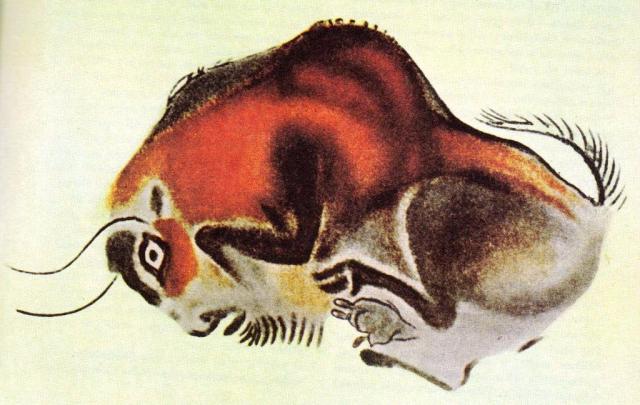
The study of cave art continues to produce new revelations. For example, Suzanne Villeneuve of the University of Victoria has recently shown that the best paintings, the ones demonstrating the most skill, tend to be in places where the most people could see them. That would be in the larger galleries with the best surfaces for both working and viewing. A striking example is a cow painted high on a wall in the Lascaux caves in France. Up close, where the artist would have been working, the proportions of the cow look wrong. It’s too tall. From down on the floor, though, it looks normal. This shows that the artist painted it with the viewers in mind. Meanwhile, the less skilled artists had their work relegated to more obscure areas.
The paintings have naturally attracted the most interest. Their beauty and excellence make them the obvious point of the exercise. No one paid much attention to the smaller marks that were seen in the caves. Of course scholars made a note of them. Like good scientists they recorded everything. But before Genevieve von Petzinger, also of the University of Victoria, no one gathered all these records together for comparison. She decided to make it her masters project. She brought together all the records of signs found in 146 cave sites in France, covering a period from thirty-five thousand to ten thousand years ago. The results were rewarding. There is a continuity of the same signs appearing in many different sites over thousands of years.
The signs include simple lines, angles, zig-zags, dots, circles, squares, triangles and other basic, easily reproduced forms. The whole set amounts to twenty-six, and subsets of the same marks are found in the French caves as well as at sites in Africa, the Americas, Asia and Australia. Their existence, their persistence over time and their widespread ubiquity seem to indicate that they were more than incidental doodles. They would seem to be evidence that people were using symbols to express ideas long before the first examples of pictographic writing five thousand years ago. While most of the cave symbols appear individually, some are in groupings, a tantalizing suggestion that they were put together to convey a new idea.
Evidence suggests that the symbols were well established by at least thirty thousand years ago, rather than later, so it’s easy to assume that the people were using them before they migrated to Europe. Before now there was a consensus that humans had a cognitive and creative explosion about then, but these new findings will probably push that back, perhaps to a hundred thousand years or even further.
As with the paintings themselves, the meanings of these symbols might never be known, but they can still tell us something. Our ancestors were recording their thoughts long before we thought they were.
rjb