Photo credit – Unhindered by Talent
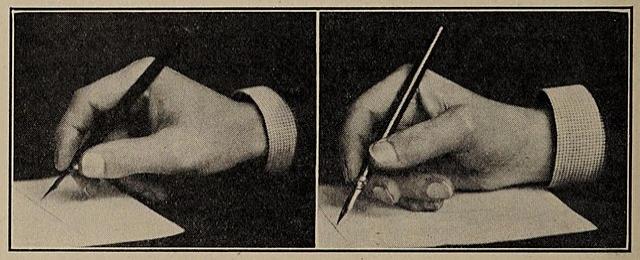
Humans show a strong preference in which hand they use for most tasks. The things that require the most dexterity and fine control are done by our preferred hand. Things like writing, for example, people do well with one hand and horribly with the other. The majority of people, around 90%, are right-handed. Most of the remaining 10% are left-handed, and a few are ambidextrous, or equally able with both hands.

Credit Guy Rich Caswell – Public Domain
There has been debate and disagreement as long as can be remembered about handedness. Why is it there? What causes it? Does one’s handedness indicate the presence or lack of moral rectitude? Well, that last question is positively anti-scientific, but that doesn’t stop it being asked.
As for what causes handedness, it’s been shown that the distribution of it and the hereditary nature of it indicate that it’s genetic. Not only that, but it’s most likely that it’s all down to one gene with both a dominant and a recessive version. A child’s handedness is determined by which versions of the gene the parents have.
— More studies have complicated things. It’s now thought that only about a quarter of the determination of handedness is by genetics, and three quarters by environmental factors. Refer to the Wikipedia article on handedness.
The two forms of the gene aren’t simply a right-handed version and a left-handed version. If that were so, it wouldn’t explain how two left-handed parents could have a right-handed child, or how identical twins can sometimes be oppositely handed. Instead, the researchers are describing the dominant version as right-handed and the recessive one as random. So, of the pair of copies of the handedness gene that a child gets, if even one is dominant they are right-handed. If both are recessive then the child could be left- or right-handed. Hence the definition of the recessive gene as random.
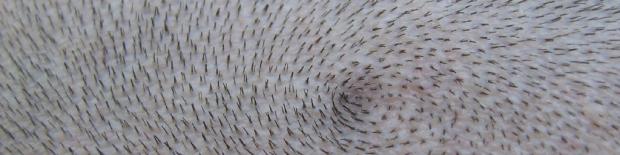
Oddly, there’s a link between handedness and the direction the hair grows. As the hair swirls away from the crown of the head it either turns to the right, clockwise, or to the left, counterclockwise. Almost all right-handers have clockwise whorls, while left-handers and the ambidextrous have whorls which randomly go one way or the other.
The one gene seems to be both a right-handed/random gene and a clockwise whorl/random gene. If you get two copies of the random variant from your parents you have a 50/50 chance of being left-handed, and if you’re left-handed you have a 50/50 chance of having a counterclockwise hair whorl.
And now, after all that, here is something that might debunk the whole idea of a link between handedness and hair whorls. For that, go to the University of Delaware and their series on the Myths of Human Genetics.
rjb