Cap Cloud

Photo credit - Anne Burgess - CC-BY-SA

Photo credit – Anne Burgess – CC-BY-SA

Cloud of the Day – Cap Cloud

Cap cloud (link to a super photo on the Astronomy Photo of the Day website) is similar to pileus in that it forms on top of another structure. In the case of pileus, the other structure could be a cumulonimbus cloud or a volcanic plume. Cap clouds, on the other hand, are found on permanent structures, such as mountain peaks. Cap cloud is defined at Weather Online as a “. . . stratiform, orographic cloud that hovers above or over an isolated mountain peak.” “Orographic” means that the lifting mechanism that raises the moisture-laden air to the condensation level is the terrain. And “stratiform” means that the cloud is more layer-like than vertical in its development. In these ways, cap cloud is also related to altocumulus lenticularis, another stratiform cloud formed by orographic lift.

Photo credit - euphro - CC-BY-SA

Photo credit – euphro – CC-BY-SA

Cap clouds form when warm, moist air is forced up over a mountain peak. When the condensation level is at or near the summit, a cloud forms in close enough proximity to merit the name. When the winds are strong enough, they smooth it out into the classic lenticular form. An interesting effect can be seen sometimes when you’re on the lee side of the mountain. As the air flows over the top of the mountain and down your side, it warms up again and evaporation causes the cloud to disappear partway down. If you look closely, you can see the cloud constantly flowing over the mountain, then vanishing, an effect I was lucky enough to see at Cook Mountain in New Zealand.

Photo credit - Bojan Dodoc

Photo credit – Bojan Dodoc

Cap cloud is not associated with precipitation, given that the air is necessarily drier at lower elevations.

Photo credit - Colin Sue Brown

Photo credit – Colin Sue Brown

rjb

Posted in Uncategorized | Tagged , , | 2 Comments

Summer Ending

Photo credit - Brandt Leinor

Photo credit – Brandt Leinor

With summer ending and gently folding into autumn, it’s time to post a few more photographs of my area. You can’t all be here, but at least I can let you have a look at it.

Photo credit - Jeremy Cook

Photo credit – Jeremy Cook

Photo credit - Brian Fry

Photo credit – Brian Fry

The header photo by Brandt Leinor centers on one of the most iconic landmarks around here, only from the back. The next two show the river in the next valley over caught in a serene moment by Jeremy Cook, and an Electra water bomber at work by Brian Fry. The bottom two begin to set the mood for the passing season with a barn in the moonlight by Brandt Leinor and a barred owl by Jeremy Cook.

Photo credit - Brandt Leinor

Photo credit – Brandt Leinor

Photo credit - Jeremy Cook

Photo credit – Jeremy Cook

Glad to share the beauty. Click the photos for the big originals.

rjb

Posted in Uncategorized | Tagged , , | 2 Comments

Zodiacal Light

Photo credit - Malcol - CC-BY

Photo credit – Malcol – CC-BY

Cloud of the Day – Zodiacal Light

Photo credit - Brian Minkoff - CC-BY-SA

Photo credit – Brian Minkoff – CC-BY-SA

Brian May played guitar for Queen. That’s Queen, not The Queen, although Queen might have played for The Queen. I don’t know. It seems unlikely, though. On the other hand, Brian May was awarded a CBE (Commander of the Most Excellent Order of the British Empire) in 2005, so maybe he got to play for The Queen after that.

Photo credit - Faulkes - CC-BY-SA

Photo credit – Faulkes – CC-BY-SA

More importantly for our purposes here, May has a PhD in astrophysics. He began his studies as a young man, graduating from London’s Imperial College with a BSc, before beginning his PhD studies on phenomena related to zodiacal light. The success of Queen distracted him from his studies and he wasn’t able to complete his PhD thesis until 2007, more than thirty years later. Fortunately for him, interest in the zodiacal light was so sparse in the interim that his thesis was still valid.

Photo credit - A. Fitzsimmons - CC-BY

Photo credit – A. Fitzsimmons – CC-BY

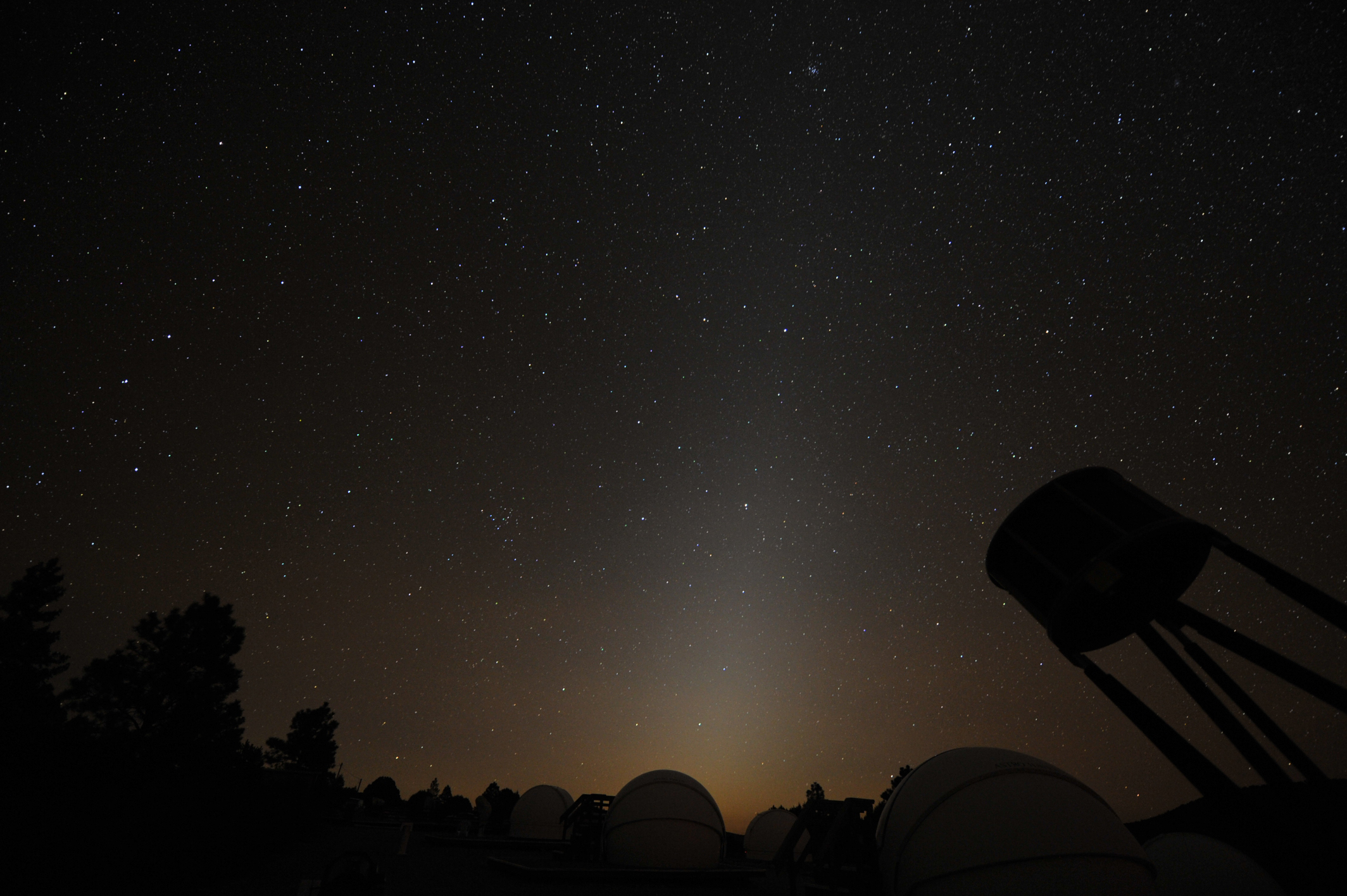
Zodiacal light is a faint glow that can sometimes be seen in the sky just before dawn or just after sunset. Sometimes it’s called false dawn because it can fool you into thinking that the Sun is about to rise. Zodiacal light is faint. It’s fainter than the Milky Way. You won’t see it if you’re in a city, or subject to any other light pollution. Even moonlight can wash it right out. The source of zodiacal light is sunlight reflecting off cosmic dust in a disk around the Sun. The disk is flattened by its rotation and lies on the plane of the ecliptic, just like the planets. Hence the zodiac, which is the collection of constellations around the plane of the ecliptic. It’s best observed in spring after evening twilight, and in autumn before morning twilight.

Photo credit - Y. Beletsky - CC-BY

Photo credit – Y. Beletsky – CC-BY

Zodiakallicht - Public domain

Zodiakallicht – Public domain

Zodiacal light isn’t really a meteorological phenomenon, but it’s pretty close.

Some of the pictures link to larger versions.

rjb

Posted in Uncategorized | Tagged , , | Leave a comment