Cavum

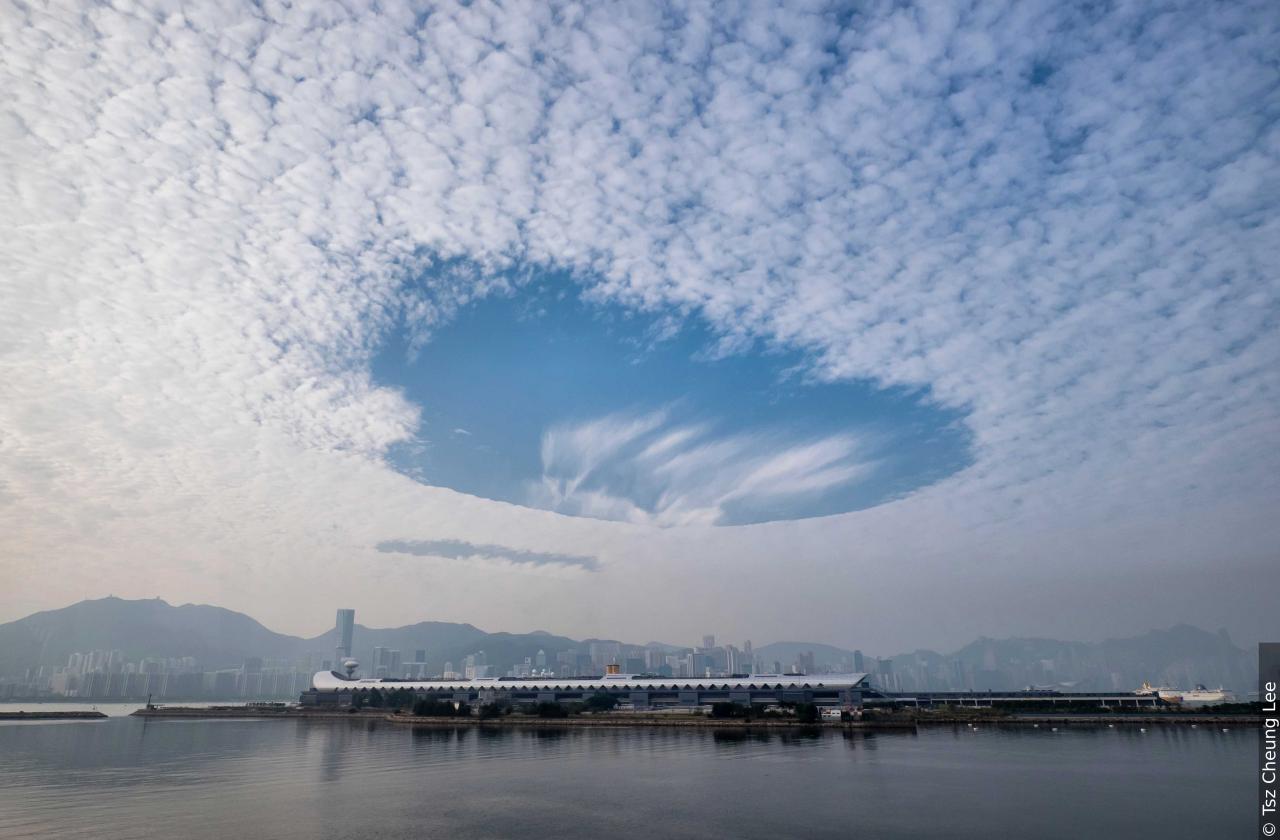
Copyright Tsz Cheung Lee

Cavum is one of the new clouds that show up in the latest edition of the World Meteorological Organization’s International Cloud Atlas. I reported on the release of the new edition in this post. Cavum is really just a new name for a cloud type previously known as a fall streak hole, which I reported on here. There are more great pictures in that post. The full name for the example shown in this post is altocumulus stratiformis perlucidus translucidus cavum. That is, the middle etage cloud altocumulus (my previous post on altocumulus) which is in a layer thin enough to allow light through, and which has gaps between its elements and a great big hole with virga in it. Here’s how cavum is described in the International Cloud Atlas.

A well-defined generally circular (sometimes linear) hole in a thin layer of supercooled water droplet cloud. Virga or wisps of Cirrus typically fall from the central part of the hole, which generally grows larger with time. Cavum is typically a circular feature when viewed from directly beneath, but may appear oval shaped when viewed from a distance.

When resulting directly from the interaction of an aircraft with the cloud, it is generally linear (in the form of a dissipation trail). Virga typically falls from the progressively widening dissipation trail.

Occurs in Altocumulus and Cirrocumulus and rarely Stratocumulus.

And here’s the description of the image from the International Cloud Atlas.

This thin, translucent and extensive layer of cloud is Altocumulus stratiformis translucidus. In the top part of the picture it also displays the variety perlucidus, as there are the gaps between the cloud elements. However, the most striking feature is the large, roughly circular hole beneath which there is virga. The large hole is the supplementary feature cavum, popularly known as a “fallstreak hole” or “hole-punch cloud”. The full classification for the cloud is therefore Altocumulus stratiformis perlucidus translucidus cavum.

Also of note is a linear gap in the cloud between the fallstreak hole and the horizon. This is an aircraft dissipation trail, or distrail, formed as a result of an aircraft flying through the cloud layer. Informally this is sometimes known as a “canal cloud”. It later transformed into a circular-type hole.

The supplementary feature cavum is formed when glaciation occurs in a thin cloud layer consisting of supercooled water droplets that are in a liquid state and at a temperature below 0°C. As the supercooled water drops glaciate, the resulting ice crystals fall from the cloud layer to a lower level as virga, or fallstreaks. The resulting cloud hole typically grows larger with time while the glaciation process continues.

There’s not much I can add to that, except to invite you to visit the International Cloud Atlas website.

rjb

Posted in Uncategorized | Tagged , , , , | 2 Comments

Measuring Dimensions

Credit SiBr4 – CC-BY-SA


We live on a rocky ball about 12,750 kilometers through and 40,050 kilometers around its widest diameter. It has a mass of about six quadrillion megatonnes, which is so ridiculously large compared to things we’re used to that it doesn’t really mean anything to us. Our size compared to Earth’s size is roughly equivalent to the size of viruses compared to us.

That is not to imply that humans are like germs living on Earth. It just provides some perspective on where we are. To go a little further, the next level at the same ratio compares the size of the planet Earth to the size of the whole Solar System. Give or take a few billion kilometers. It’s not an analogy that can stretch forever. (Here’s a link to a video that goes from the very small to the very large – 10 minutes)

And it doesn’t imply that humans are merely an unimportant example of a repeating theme. After all, why is our size one of the levels? We could just as easily be included with all of life to fall between the very small and the very large. As in – subatomic particles – living things – planets and stars. But that’s another analogy that shouldn’t be pushed too hard.

We choose humans as a level because we’re human. We tend to look at things relative to what we’re used to, so we don’t think twice about our size being one of the steps on the ladder. Besides, it was necessary to use something familiar as a point of reference in such a wide array of dimensions.

The dimensions of the physical universe are measured by such huge numbers, both hugely big and hugely small, that they don’t convey much meaning on their own. The very large is measured in billions of light years. Light years are trillions of kilometers each. Even a single kilometer is big compared to us. The small is measured in fractions of meters, changing the numbers from positive to negative right about our size. The very smallest things are such small decimals of a meter that we don’t write them out in full, using special mathematical shorthand instead.

In all that vastness, all that range of realities and possibilities, what is most amazing is that part of it is conscious. A narrow band in the middle has produced something that can look out and try to understand the whole thing.

I think we can justify being a little self-centered.

Posted in Uncategorized | Tagged , , , , , , , , , | Leave a comment

Two Spaces

Grammar of the Day – Two Spaces

There should be two spaces after a full stop. I know everyone says there should only be one. The style guides agree with them. Even this blog software agrees with them, turning all of my double spaces into singles. The one-spacers say we two-spacers are living in the past. They say that two spaces might have been needed when people were using those old-fashioned printing presses, but not now with our modern technology. They say we’re stubborn. Luddites, even. They dismiss us with condescension. They’re blithely sure that they’re right and we’re wrong, but they’re mistaken.

I have challenged one-spacers with eight little words, and not one of them has been able to meet the challenge. My challenge: Is this one sentence or two?

“When I was dying?” Fran finished for him.

The only way to know for sure is if full stops are consistently followed by two spaces. As it is, we don’t know if that question mark is at the end of a sentence, or in the middle of one. For clarity of communication, we have to bring back the double space.

So there.

rjb

Posted in Uncategorized | Tagged , | 2 Comments