Alien Life on Titan

Photo credit - Cornell University Photography

Photo credit – Cornell University Photography

I thought I had published this article on solvent as the medium for life. I guess I was wrong. Today I was reminded of it by this article about some scientists who are trying to figure out what kind of life could evolve in liquid methane on Saturn’s moon Titan.

From the Eurekalert article:

“. . . many astronomers seek extraterrestrial life in what’s called the circumstellar habitable zone, the narrow band around the sun in which liquid water can exist. But what if cells weren’t based on water, but on methane, which has a much lower freezing point?”

“The azotosome (the material proposed for cellular life in liquid methane) is made from nitrogen, carbon and hydrogen molecules known to exist in the cryogenic seas of Titan, but shows the same stability and flexibility that Earth’s analogous liposome (the basis of our water based cells) does.”

The azotosome - Credit - James Stevenson

The azotosome – Credit – James Stevenson

And here’s my five year old article called “Solvent.”

On Earth the ultimate solvent is water. It lies on the planet in great swaths, covering almost three-quarters of it. But it doesn’t just lie there. It circulates around the continents in huge streams and mixes itself in small eddies. And it doesn’t just move horizontally. Water rises up into the atmosphere as a vapor and spreads out over the globe. In the air, water can take many forms. It can remain a vapor or it can condense out in tiny droplets or ice crystals, which can float in the atmosphere almost indefinitely. All the water will eventually complete the cycle many times over the eons, though. It will condense into drops or flakes or pellets and fall, some of it landing on the ground and finding its way back to the sea. While it’s doing all this it’s also acting as a solvent. Everywhere it goes it’s carrying all sorts of things that have dissolved in it. Water holds lots of interesting molecules that can engage in some creative acts of chemistry. And where there’s chemistry there are the raw materials for life. On Earth liquid water is the solvent that makes it possible.

The nagging question of whether there’s life on Mars hinges on the existence of water, preferably liquid, to support it. Were there Martian seas in the past? Is there water underground now? We know the planet has water thanks to the obvious polar ice caps, but we’re not sure if there’s enough to maintain a biological system. There’s encouragement in the fact that life exists on ice here on Earth. If Mars has plenty of permanent ice underground it might have a subterranean biosphere.

Farther out there are moons of Jupiter and Saturn that probably have global oceans under thick crusts of ice. Does any interesting chemistry happen there?

Also orbiting Saturn is a cloud-shrouded moon called Titan. It’s a large moon, about fifty percent bigger than our own, and bigger than the planet Mercury. Probes sent from Earth have studied it and found that it has plenty of useful molecules in its atmosphere and on its surface. It also has liquid methane oceans, lakes, rivers and rain. What kind of chemistry would go on there?

We’ve tacitly assumed that extraterrestrial life would be found, if at all, in the presence of water. Now some biologists are wondering if water’s required. Maybe some other solvent like liquid methane would do. While water is the ultimate solvent here, elsewhere it could be something else.

rjb
Posted in Uncategorized | Tagged , | Leave a comment

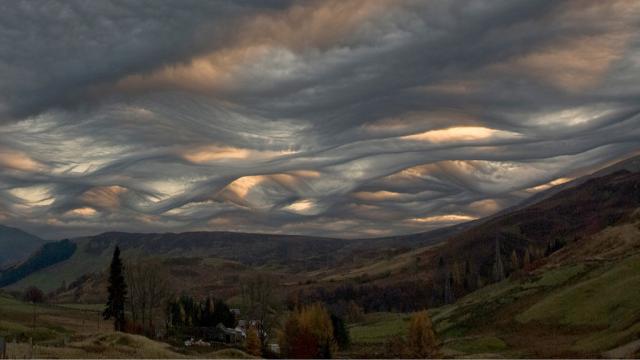
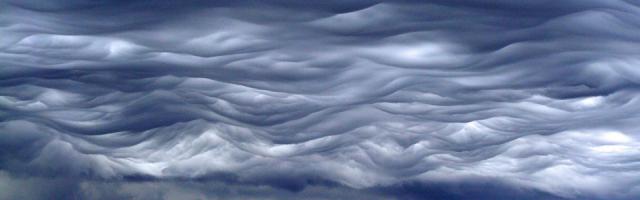
Asperatus

Asperatus-Heimo-Lauhaluoma
Cloud of the Day – Asperatus

Asperatus, also known as undulatus asperatus and altocumulus undulatus asperatus, is biblical. It’s the kind of cloud that makes people think that the world might be at the mercy of supernatural forces. They might fall to their knees and beseech their wrathful gods for mercy. Other people might look at them and say, “So, that’s where van Gogh got it from.”

Photo credit - Ken Prior

Photo credit – Ken Prior

Asperatus, loosely meaning “roughened waves,” is thought to form under the same kind of conditions as mammatocumulus, only with winds strong enough to shear the mammatus bulges into wave-like undulatus forms. This cloud hasn’t yet been officially named and added to the World Meteorological Organization’s definitive International Cloud Atlas. The Atlas was most recently published in 1975. The last time a cloud was added was 1951. The jury is out on whether asperatus will be added to the Atlas, and no one expects it to be soon if it is.

Note: The World Meteorological Organization has added asperatus — renamed asperitas — to the International Cloud Atlas (see this Green Comet post) in its fifth edition published in 2017.

Photo credit - Agathman - CC-BY

Photo credit – Agathman – CC-BY

The Cloud Appreciation Society has been very important in the discovery of this new cloud type, especially its founder, Gavin Pretor-Pinney. The society has thousands of members who send in beautiful photographs of clouds, and it has a nice selection of asperatus. Because of the way their site is set up, I can’t link directly, so you’ll have to search on “asperatus.”

Photo credit: Ave Maria Mõistlik – CC-BY-SA

Asperatus is not a harbinger of stormy weather, more often appearing as the weather abates.

Photo credit - NASA - PD

Photo credit – NASA – PD

rjb

Posted in Uncategorized | Tagged , , , , | 3 Comments

Mandatory Labels on Food Containing DNA

dna-food-aisle
Just over 80% of Americans surveyed would agree with a government policy for mandatory labels on food containing DNA. That is almost the same as it is for mandatory labels on food produced using genetic engineering, which is just over 82%. This information is available in a food survey conducted by Oklahoma State University, available as a downloadable PDF file.

Here is a sample label proposed by Ilya Somin of the Washington Post. Tap this for his full article.

“WARNING: This product contains deoxyribonucleic acid (DNA). The Surgeon General has determined that DNA is linked to a variety of diseases in both animals and humans. In some configurations, it is a risk factor for cancer and heart disease. Pregnant women are at very high risk of passing on DNA to their children.”

Is this meant to mock the pervasive ubiquity of scientific ignorance? It could be. That would be so easy. There are many stories about the many people who think the Sun orbits Earth, for instance. It would seem that anyone who believed that would be likely to believe that DNA is a dangerous food additive. The problem is, about three times as many people appear to be ignorant about DNA than about the Solar System. This is bad because food labels have a much greater impact on people’s everyday lives than do celestial mechanics. If ignorance leads to putting this useless information on food labels, it would not only waste the precious time of people reading them, it would also undermine the labels’ usefulness.

USFDA - Public domain

USFDA – Public domain

We mustn’t mock or criticize the high levels of scientific ignorance among ordinary citizens. We could ameliorate it somewhat with a more rational and effective education system, but there is a more effective way to address the problem. If we could eliminate the ignorance among legislators and rule-makers, then this problem would disappear. If we could ensure that no one that foolish would ever be in a position to foist such a thing on ordinary citizens, then ordinary citizens wouldn’t have to worry about it.

Besides, everyone knows that it’s the dihydrogen monoxide that’s the real problem.

rjb

Posted in Uncategorized | Tagged | 4 Comments