Patent suits still battered tech companies in 2015

Further to my last post about the Electronic Frontier Foundation’s Stupid Patent of the Month, here’s an analysis of the ongoing pain being caused by so-called patent trolls, more politely called non-practicing entities (NPEs.) That’s a term to describe entities that hold patents but don’t use them for anything, except sometimes to sue people who are producing things.

Not all NPEs are patent trolls, though. That would be too simple. Some of them are universities that do research but don’t directly try to employ their discoveries. So, they hold patents but don’t use them, the very definition of NPE. All this makes it difficult to fashion solutions to the patent troll problem. Nearly everyone agrees that the trolls are a problem. Other than from the trolls and their lawyers, you don’t see much justification for their parasitical behavior. But lawmakers have to be careful that they don’t damage innocent bystanders along with the trolls.

From the Christian Science Monitor article:

Tech companies faced a growing wave of patent suits in 2015 from so-called non-practicing entities, which hold patents but do not create products based on them.

Universities … (say) … the proposals go too far by potentially categorizing them as patent trolls.

… contrary to the perception of NPEs as mostly patent trolls, some inventors have also repeatedly filed claims, particularly for software and hardware.

Once again we have to find that fine line between rewarding innovation and creativity, and letting it turn into a farce that punishes those who do and rewards those who sue.

Source: Despite crackdown from courts, patent suits still battered tech companies in 2015 – CSMonitor.com

rjb

Posted in Uncategorized | Tagged , , | Leave a comment

Electronic Frontier Foundation Stupid Patent of the Month: Microsoft’s Design Patent on a Slider

Patents are good. They encourage innovation. Software patents are bad. They encourage trolling. The Electronic Frontier Foundation keeps an eye on these things. They monitor the complex and usually boring details of our electronic existence, and try to warn us when it threatens to go awry. An example of their awareness-raising is their Stupid Patent of the Month award, which goes to Microsoft for December 2015. Microsoft filed a design patent for a slider, as in the picture above, and now they’re suing Corel for patent infringement.

stupid-patent-square-2

For the first time ever, this month’s Stupid Patent of the Month is being awarded to a design patent. Microsoft recently sued Corel for, among other things, infringing its patent on a slider …

Microsoft’s patent claims against Corel are unsurprising in light of how much money is potentially at stake. If Corel is found to infringe even one of Microsoft’s design patents through even the smallest part of Corel Home Office, current Federal Circuit law entitles Microsoft to all of Corel’s profits for the entire product. Not the profits that can be attributed to the design. Not the value that the design adds to a product. All of the profit from Corel Home Office.

All of their profits for their Corel Home Office product would be forfeit for the use of one stupid, obvious design feature. The current patent system is, rather than encouraging innovation, rewarding parasitical laziness. That is the opposite of what the system was created for. To me, this shows that the public institutions in charge of the system are just as bankrupt as the system itself.

In addition to the article on the EFF site, here is some good coverage at Ars Technica.

Source: Stupid Patent of the Month: Microsoft’s Design Patent on a Slider | Electronic Frontier Foundation

rjb

Posted in Uncategorized | Tagged , | Leave a comment

Error 451: How to tell when websites have been censored

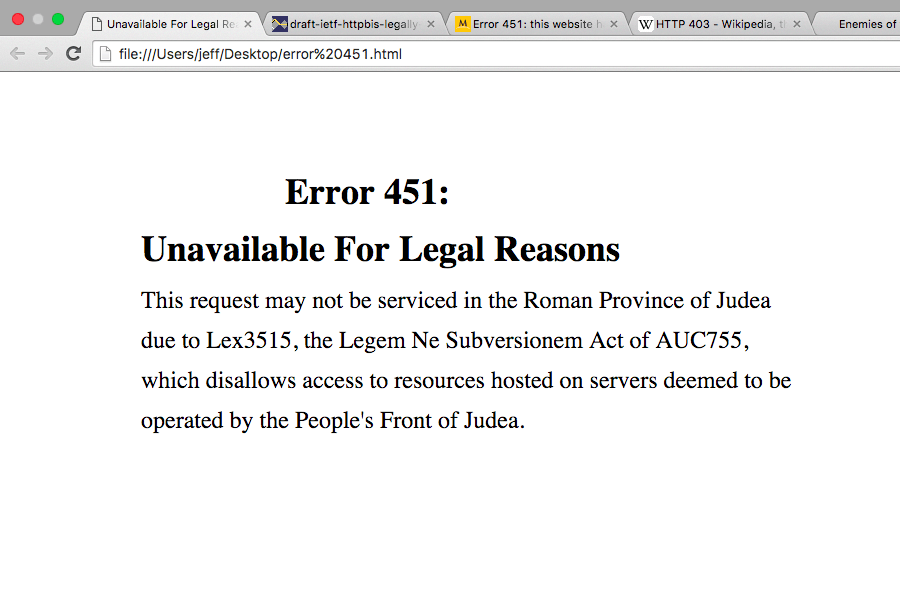
I like an open Internet. So I like it when the censors are exposed, and we can tell when a website has been deliberately blocked. This new error code — 451, as in Fahrenheit 451 — is meant to do just that. As a bonus, notice the subversive nature in the example in the picture.

A new online error code tells users when a site is unavailable for legal, rather than technical, reasons. Error 451, a nod to Ray Bradbury’s novel ‘Fahrenheit 451,’ indicates that a site has been censored by a government.

Source: Error 451: How to tell when websites have been censored – CSMonitor.com

Posted in Uncategorized | Tagged , , | Leave a comment